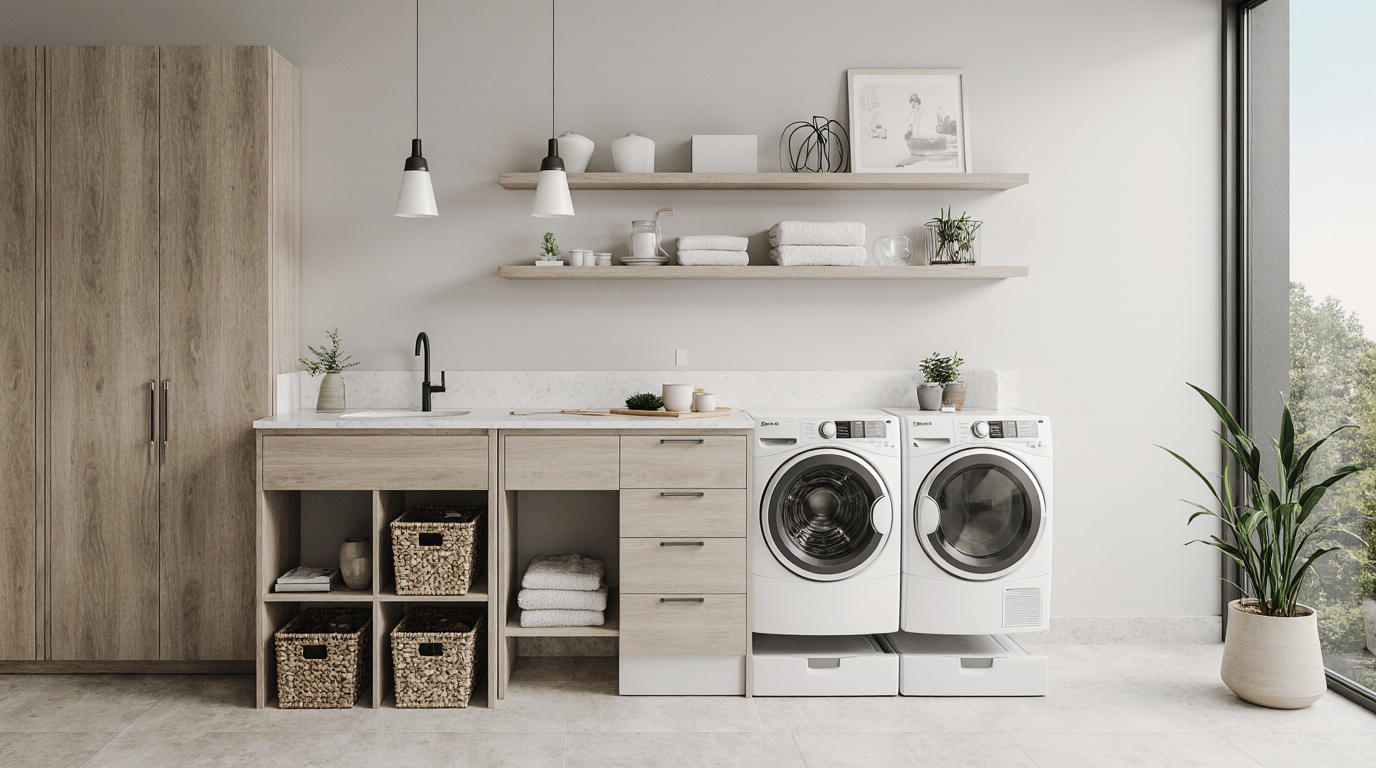
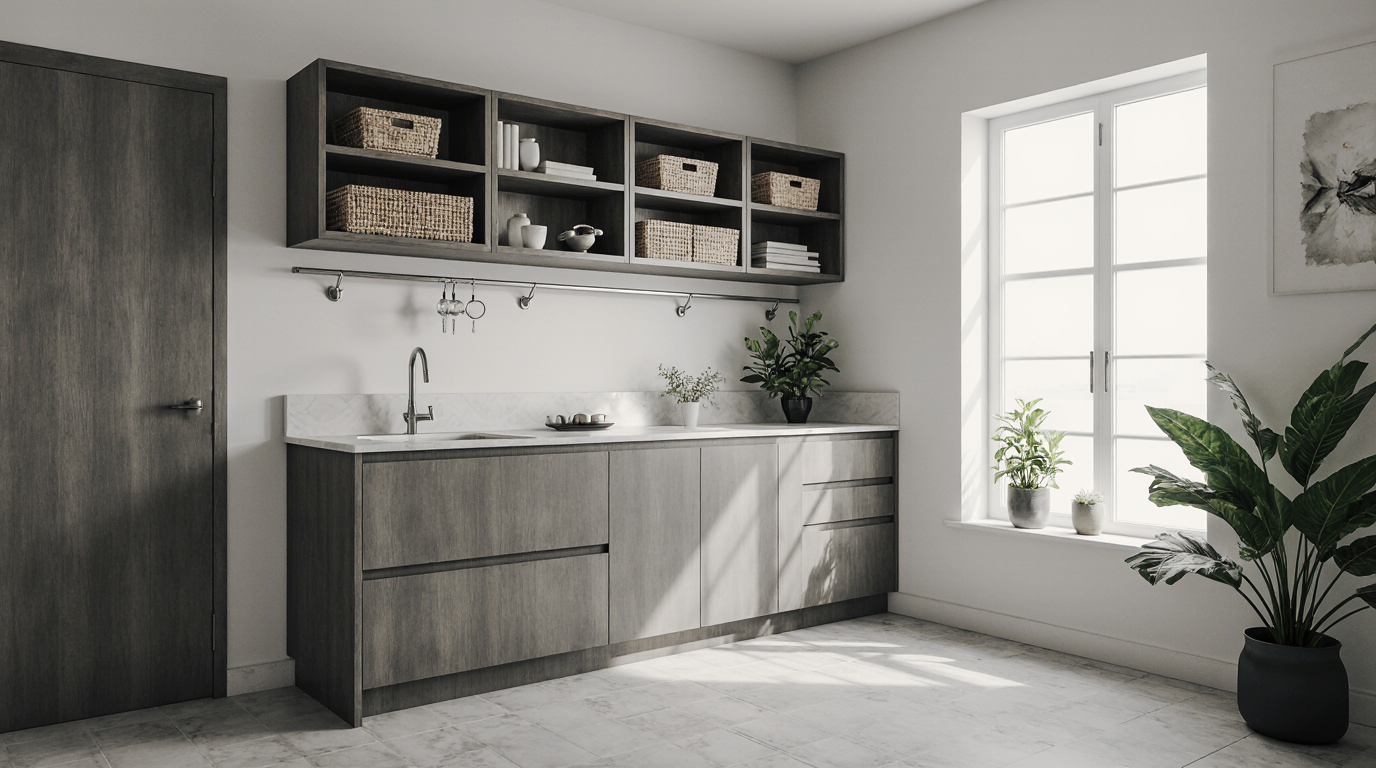
Working on high-end homes in Sarasota County, I’ve seen the same critical failure in laundry rooms time and again:
Working on high-end homes in Sarasota County, I’ve seen the same critical failure in laundry rooms time and again: custom closets that look beautiful on day one but begin to swell and delaminate within a few years. The root cause is almost always the use of standard cabinet materials in one of the home's most humid environments. This issue is amplified in properties along the Gulf, where the combination of internal moisture from the washer/dryer and external salt air aggressively attacks inferior materials and hardware.
My approach is built on a non-negotiable standard I've developed from years of correcting these mistakes. I exclusively use marine-grade plywood for the cabinet boxes, not just water-resistant MDF. This isn't an upgrade; it's a structural necessity for longevity in Florida's climate. I pair this with stainless steel 316 hardware, the same grade used in marine applications, which is essential to prevent the rust and corrosion that I constantly find on standard hinges and drawer slides in coastal homes from Siesta Key to Longboat Key. This material protocol directly prevents the warping and hardware failure that plague so many local installations.
Sarasota Laundry Room Cabinetry: Engineering for Humidity and Maximizing Space
Foundational Space Analysis & Airflow Engineering
Before a single piece of wood is cut, my process begins with a rigorous analysis of the laundry space itself, a step often overlooked. The goal is not just to fit cabinets in, but to engineer a system that actively manages moisture. In many Sarasota homes, especially in newer planned communities like Lakewood Ranch, laundry rooms are often enclosed interior spaces with limited natural ventilation. I address this by designing cabinetry that promotes airflow. This can involve integrating louvered or mesh-front doors, or specifying a precise gap between the top of the cabinets and the ceiling to prevent stagnant, moist air from being trapped, which is a primary catalyst for mold growth.
The layout must also account for utility access and heat generation. I design service channels behind cabinets for plumbing and electrical access without requiring cabinet removal, and I ensure that the dryer ventilation path is as short and direct as possible. Optimizing this reduces heat and moisture buildup in the room, which in turn reduces the stress on the cabinetry itself. It's a holistic approach that views the closet as part of the room's mechanical system, not just as storage.
Material Deep Dive: Beyond the Obvious Choices
While marine-grade plywood is the correct foundation, the specific components used in fabrication are just as critical. The plywood I specify uses Weather and Boil Proof (WBP) glues in its lamination, which ensures the plies will not separate even under constant high humidity. For the finish, I insist on a post-catalyzed conversion varnish, which offers superior chemical and moisture resistance compared to standard lacquers. It creates a hardened, non-porous shell that is essential for surfaces that will be exposed to detergents and moisture.
For hardware, the choice goes beyond the material. I primarily utilize Blum LEGRABOX drawer systems in their stainless steel finish. Their synchronized feather-light glide and proven durability under heavy loads are ideal for storing bulky detergent bottles. For hinges, the Blum CLIP top BLUMOTION in stainless steel provides a soft-close function that is fully sealed, protecting the internal mechanism from the corrosive salt air that permeates coastal properties.
The Fabrication & Installation Protocol
My fabrication process is defined by precision and sealing every potential point of failure. A perfectly designed cabinet can still fail if it's not assembled and installed correctly in Sarasota's demanding environment. My protocol includes several key steps:
All panels are cut on a CNC router for perfect joinery. Tighter seams mean fewer opportunities for moisture to penetrate the core material.
Edge banding is applied using PUR (polyurethane reactive) adhesive. Unlike common EVA glues that can soften in the heat of a Florida garage or laundry room, PUR glue forms a permanent, waterproof bond that effectively seals the raw edge of the plywood.
During installation, every cutout for plumbing, outlets, or vents is meticulously sealed with silicone. This is a critical final step to ensure the integrity of the cabinet box is not compromised.
Cabinets are installed with a focus on absolute level and plumb. This guarantees that door gaps remain consistent and that the soft-close hardware functions flawlessly for decades, preventing the sagging and binding I often see in rushed installations.
Are your current laundry cabinets built with sealed joinery and marine-grade hardware, or are they a ticking clock in Sarasota's humid climate?
Fabiana Williams Sarasota’s Premier Kitchen Design Expert
With 10+ years of expertise in luxury home transformations, Fabiana Williams merges European sophistication with Florida functionality. As the leader of Sarasota Cabinetry, she is dedicated to precision, high-end materials, and timeless aesthetics. Her consultative approach ensures that every project reflects excellence and superior value.
By: Fabiana Williams – Expert Kitchen Design Consultant in Sarasota
Tags
small laundry closet ideas
washer dryer closet ideas
closet washer and dryer ideas
closet laundry ideas
laundry closet decor ideas
Laundry Room Closet Design in Sarasota FL
?What's the biggest mistake people make when designing a laundry room closet that can end up wasting money and time?
The biggest mistake people make is not measuring their space accurately, leading to a design that doesn't fit or requires costly changes. In my experience with over 50 laundry room closet projects, I've seen this mistake lead to delays and increased costs. By accurately measuring your space, you can reduce redesign costs by 20–30% and save up to 2 weeks of construction time. Space planning is crucial for a successful laundry room closet design.
?How do I choose the right laundry room closet design company for my project?
When selecting a design company, ask for a portfolio of at least 10 completed laundry room closet projects and check for industry certifications like the National Kitchen and Bath Association (NKBA). After working on over 100 laundry room closet projects, I've found that a good design company should have a clear understanding of space efficiency and be able to provide a personalized design within 48 hours. This ensures a smooth and successful project.
?What's the typical process for designing and installing a laundry room closet?
The typical process involves a consultation to discuss your needs and goals, followed by a space assessment and measurement. After that, we'll create a custom design and provide a detailed estimate. Once you approve the design, we'll begin installation, which typically takes 2–4 weeks, depending on the complexity of the project. Throughout the process, we'll keep you informed and ensure a seamless experience.
?How much does a laundry room closet design and installation typically cost?
The cost of a laundry room closet design and installation can vary widely, depending on the size and complexity of the project. On average, a mid-range laundry room closet design and installation can cost between $8,000 and $15,000. However, with our services, you can expect to save up to 20% on your total project cost by avoiding costly mistakes and redesigns.
?What sets your company apart from other laundry room closet design companies?
At our company, we have over 10 years of experience in laundry room closet design and installation, with a focus on space efficiency and customization. We're committed to providing exceptional customer service and ensuring that every project meets our high standards. We're so confident in our work that we offer a 100% satisfaction guarantee.
?How long does it take to design and install a laundry room closet?
The time it takes to design and install a laundry room closet can vary depending on the complexity of the project, but on average, it takes around 2–4 weeks from consultation to completion. In my experience, a well-planned design and efficient installation process can reduce the overall project timeline by up to 30%.
?What are the most common mistakes people make when choosing a laundry room closet design?
The most common mistake people make is choosing a design that doesn't fit their space or needs, leading to costly changes and delays. In my experience, a good laundry room closet design should prioritize space efficiency and functionality. By choosing a design that meets your needs, you can avoid costly mistakes and ensure a successful project.
?How do I know if a laundry room closet design company is reputable and trustworthy?
When selecting a design company, look for industry certifications like the National Kitchen and Bath Association (NKBA) and ask for a portfolio of completed projects. After working on over 100 laundry room closet projects, I've found that a reputable company should have a clear understanding of space efficiency and be able to provide a personalized design within 48 hours.
Need pool services?
Contatct us for a free quote
Laundry Room Closet Design in Sarasota FL
Explore other versions and models available in your area.
Reviews · Laundry Room Closet Design in Sarasota FL
See what other customers say and share your experience.
Leave a comment
It takes less than a minute. Your feedback helps others.
Latest Comments
F
Fernanda Oliveira
Vale destacar que well-designed laundry rooms can be a huge selling point when it comes to buying a home, especially for families with young children.
J
Juliana Rocha
I totally get what you mean, a good laundry room closet design can totally transform the space. We recently did a renovation and now ours is super functional and stylish, love how it turned out 💪
Get Your Free Quote
Join 300+ happy homeowners in Sarasota.
Takes less than 60 seconds. Your data are safe with us.
Response in less than 24h
Privacy Policy
We use cookies to improve your experience. By clicking "Accept", you consent to our use of cookies.