The urban home, particularly in compact living spaces or those embracing the fluid architectural layout, increasingly necessitates versatile and flexible areas. The convergence of the culinary hub and the laundry zone is a prime illustration of this spatial innovation. Going beyond the conventional separation of service spaces, the unified approach aims to forge a single fluid space where cooking and dining and washing and drying can share the same footprint. This is significantly deeper than placing a washer and dryer in an arbitrary corner; it requires sophisticated spatial choreography and a deep commitment to visual uniformity that simultaneously improves both tasks. A truly successful kitchen with laundry area configuration relies heavily on maintaining an uninterrupted workflow while flawlessly executing the art of disguise and finish compatibility.
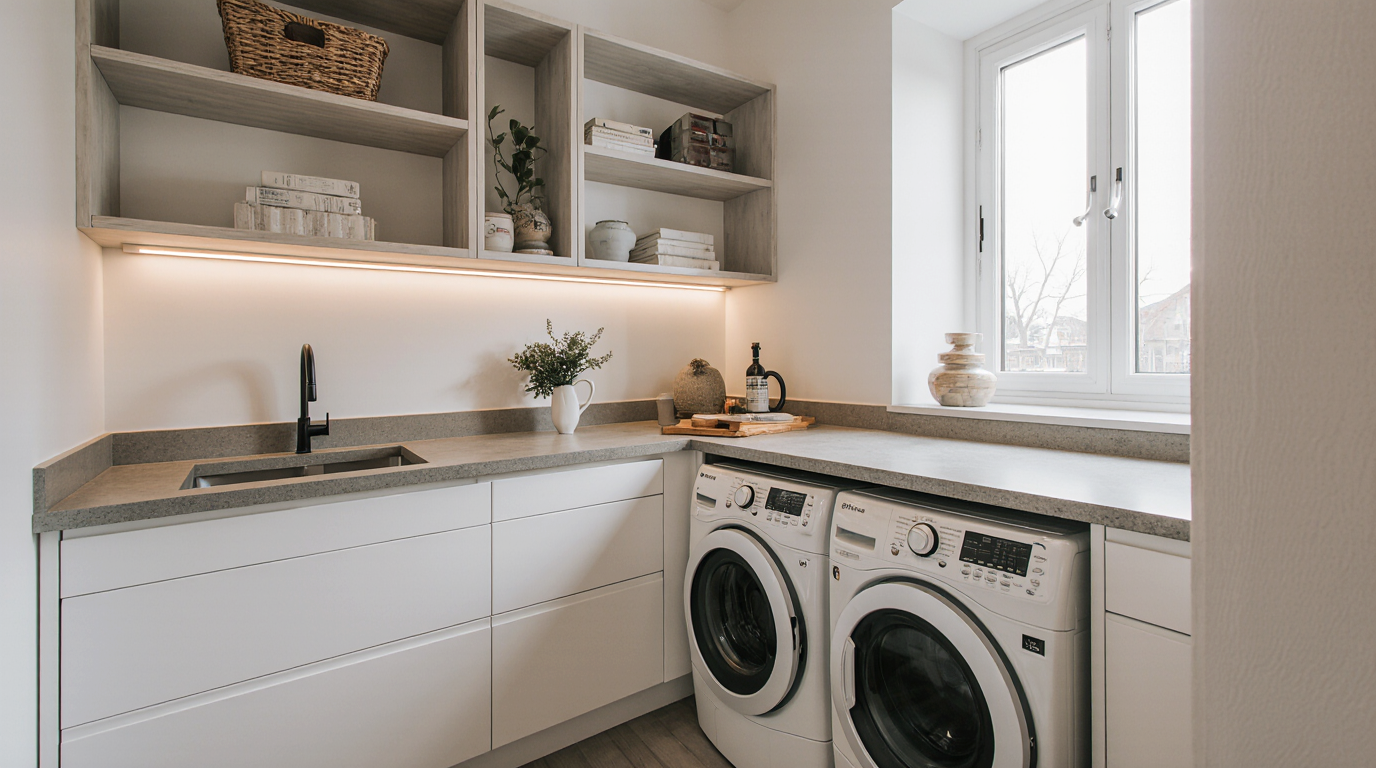
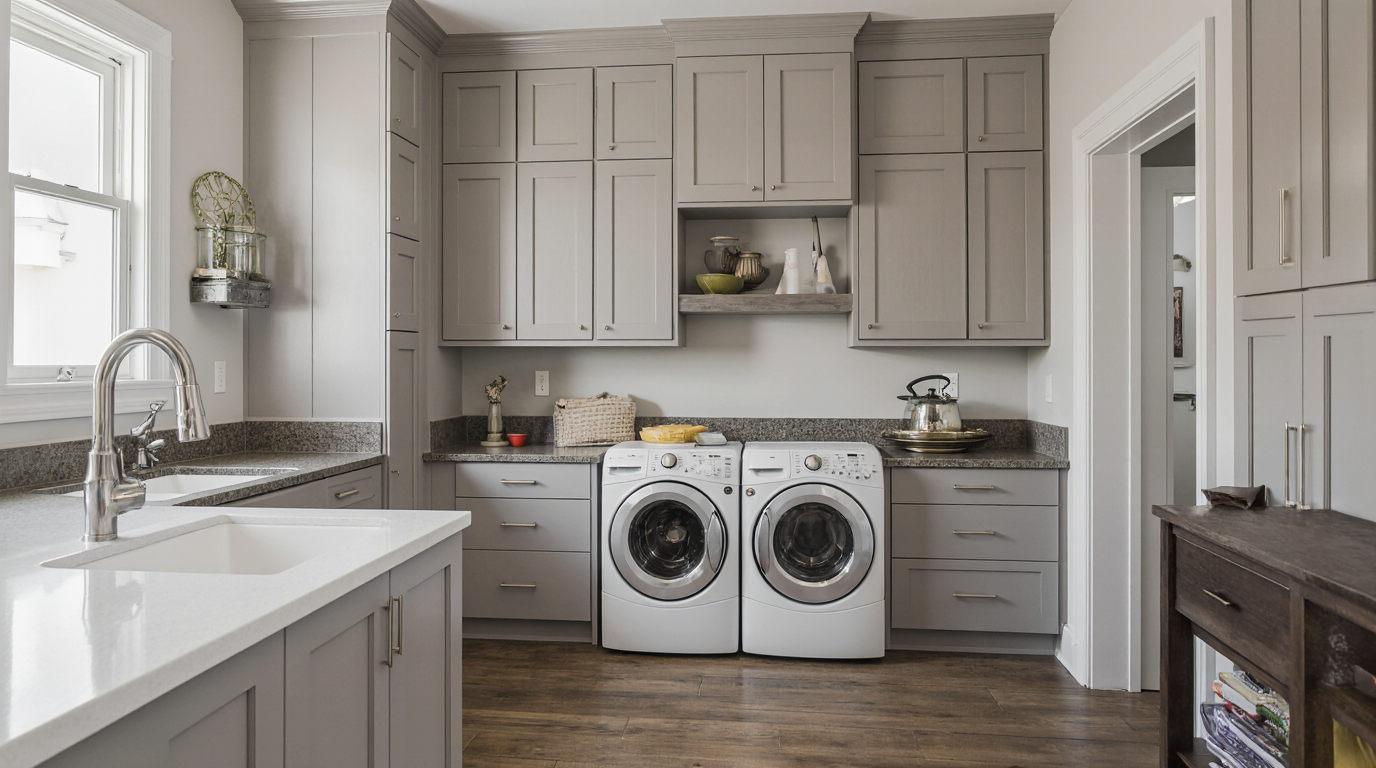
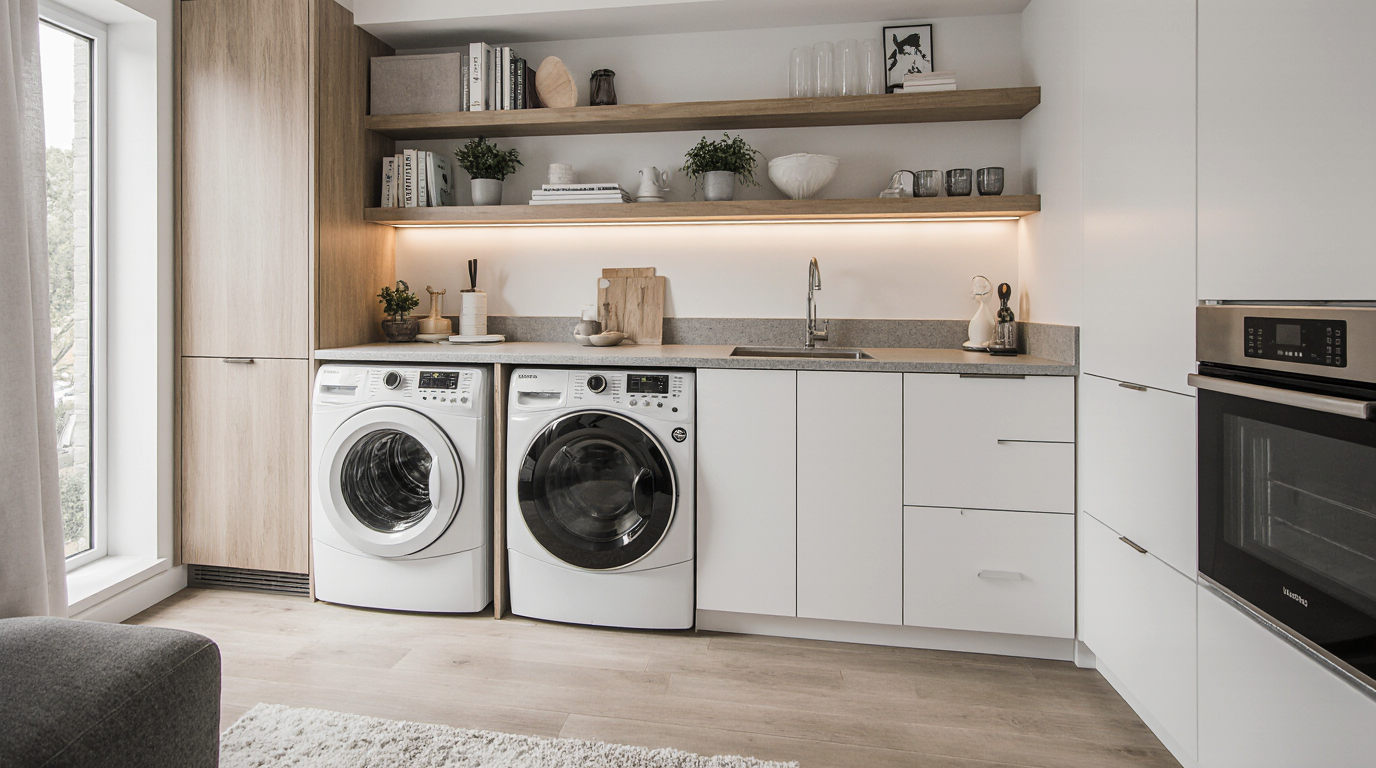
The first and foundational component is the selection and strategic placement of appliances. For genuine integration, opting for front-loading washer and dryer units is nearly always the preferred choice. Their inherent horizontal form factor facilitates the installation of a unified slab running directly over them. This expanse of surface becomes the central node of the combined zone—serving as a primary spot for meal preparation one moment, and in the next instant, transforming into a convenient stacking area for fresh, warm laundry. To optimize the ergonomics of this dual-purpose work surface, consider slightly raising the appliances by utilizing custom pedestals or integrated drawer bases, especially if stacking is not the plan. This minor elevation can dramatically improve the posture associated with loading and unloading, thereby contributing to a more comfortable daily routine. Furthermore, when confronting significant spatial limitations, vertically stackable units are the most effective spatial compromise, effectively returning valuable floor square footage back into the main kitchen's domain. Conversely, if sufficient depth is available, side-by-side placement frequently permits better circulation around the appliances and can more easily accommodate integrated cabinetry above the units.
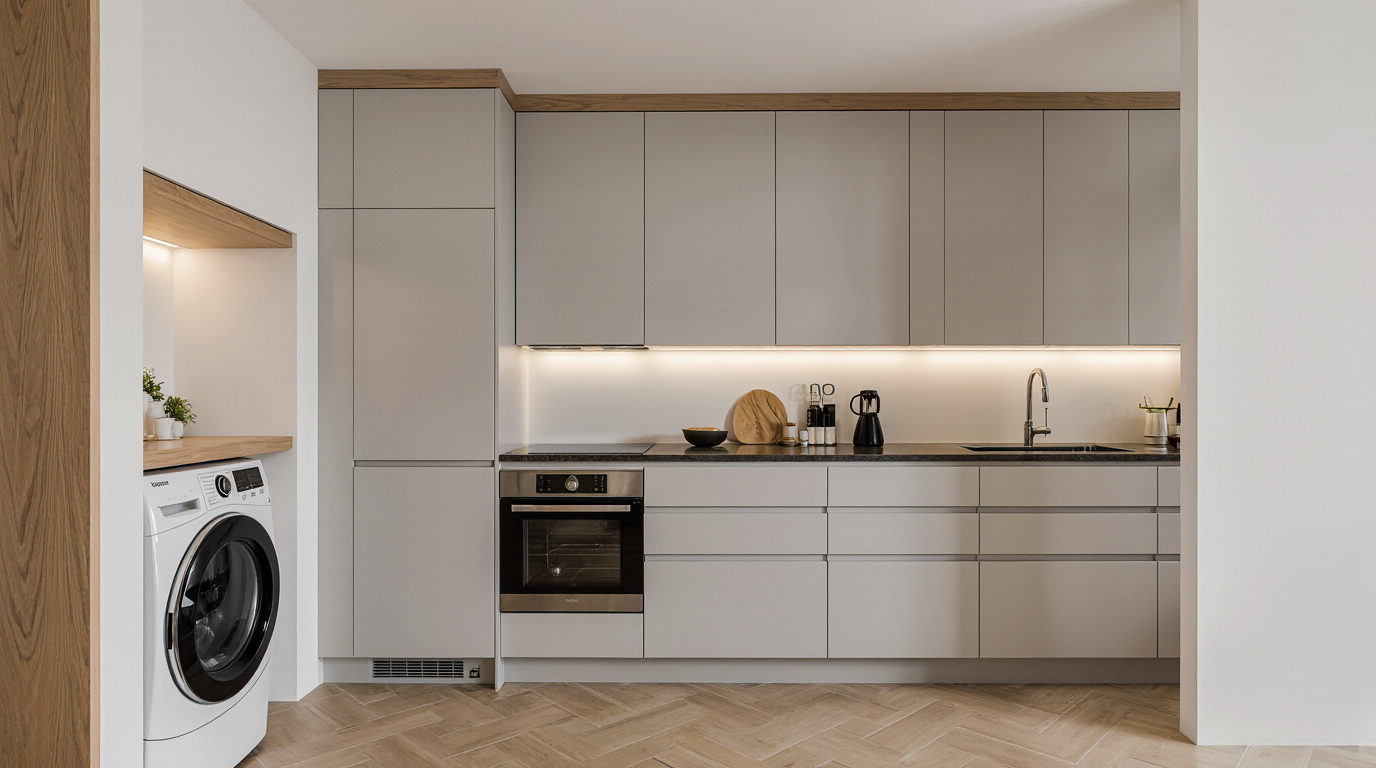
Concealment methodologies are paramount to success for preserving the aesthetic integrity of the kitchen, a space often regarded as the social center of the residence. The overarching objective is to treat the laundry portion as a fully integrated segment of the cabinet run when it is not actively being used. The most sophisticated and visually appealing solutions involve employing custom joinery that flawlessly mirrors the main storage design. This is often realized through appliances that are fully concealed behind seamless facades, often utilizing bi-fold or 'pocket' doors that smoothly retract and disappear into the frame to grant unimpeded access. When these doors are fully closed, the laundry space vanishes completely, leaving behind only the unadulterated aesthetic of the chosen kitchen design. Another ingenious technique involves integrating the machines beneath the standard counter level, subtly hidden by custom drawer fronts or cabinet panels, contingent on having enough depth and the necessary allowances for vital ventilation requirements. Even simpler, yet stylish options such as a heavy, richly textured curtain in a color or pattern that perfectly complements the kitchen's established palette can serve as a flexible screen, offering immediate utility without necessitating difficult installation.
The material selection and lighting design must work in tandem to seamlessly bridge the gap between workhorse space and refined living. To guarantee visual consistency, the finishes—including the main flooring material, the backsplash tiles, and even the cabinet hardware—should be allowed to flow uninterrupted from the primary culinary workspace into the dedicated laundry alcove. Choosing a highly durable, water-resistant countertop material such as quartz, granite, or a solid surface across the entire span ensures that the folding surface is not only aesthetically pleasing but also practical enough to manage kitchen spills or the moisture emanating from freshly dried garments. Lighting demands meticulous attention in merged areas. The chosen lighting scheme must adequately support two fundamentally different activities: bright, focused task lighting for intricate jobs like chopping vegetables or accurately spot-treating stains, and soft, general ambient light for overall kitchen usage and relaxation. Under-cabinet LED strips are extremely useful tools here, as they cast even, shadow-free light directly over the counter surface, while strategically placed recessed fixtures ensure the appliance area never feels like a poorly lit corner. Considering the design three-dimensionally, maximizing vertical storage with cabinetry that extends all the way toward the ceiling not only offers an immense capacity for seldom-used equipment or bulk household supplies but also deliberately draws the observer's eye upward, making the entire integrated zone feel taller and noticeably more expansive.
Workflow optimization for the integrated space must deliberately account for the sequence and timing of domestic chores. A thoughtfully positioned laundry station adjacent to the kitchen enables simultaneous task management—for instance, quickly tossing a new load into the machine while waiting for a pot of water to reach a boil, or folding a stack of clean shirts while supervising children engaged in homework at the nearby kitchen island. To fully support this multitasking, dedicated storage for all laundry necessities must be easily accessible yet completely out of sight. Consider using specialized pull-out drawers designed specifically to act as an organized detergent and supply rack, or built-in, clearly labeled bins for efficiently pre-sorting whites, colors, and the day's kitchen linens. A compact, wall-mounted drying rack that can retract flat against the wall or even into the ceiling when idle is crucial, as it successfully prevents clutter and preserves the clean aesthetic, offering a perfect spot for delicate items that are not suited for the tumble dryer. Even the ironing board should be allocated a dedicated, immediately accessible spot, perhaps a pull-out unit cleverly integrated into the base cabinetry. This strategy prevents the typically unwieldy and cumbersome board from perpetually leaning against a wall or unnecessarily consuming precious internal cabinet space.
The acoustics of this merged and active area introduce a singular design obstacle. The unavoidable mechanical sounds produced by the washing and drying cycles can easily and abruptly interrupt mealtime conversations or focused food preparation. Investing in premium, sound-dampening appliances is the first and most significant preemptive action. Furthermore, utilizing robust, full-depth cabinetry and even considering the installation of sound-insulating back panels within the appliance enclosure or using subtle frosted glass partitions can slightly delineate the zones visually without truly sacrificing the open-plan feeling, thereby significantly reducing noise transmission. This highly considered approach to sound management fundamentally transforms the space from a noisy utility zone that tends to intrude upon main living to a sophisticated service area that quietly supports the rhythm of modern family life. A successful integrated laundry area ultimately becomes a hallmark achievement to truly efficient home planning, definitively proving that utility does not have to result in the sacrifice of architectural elegance. It is fundamentally about designing for living in the moment, whether that particular moment involves carefully seasoning a roast or meticulously sorting the week's bath towels. The thoughtful consideration of every cabinet handle, every technical appliance specification, and every potential square inch of vertical storage capacity solidifies this area as an absolutely indispensable, yet perfectly disguised, extension of the primary culinary environment. The end product is a space that is both maximally utilitarian and flawlessly aesthetic, a true benchmark of contemporary interior design excellence.