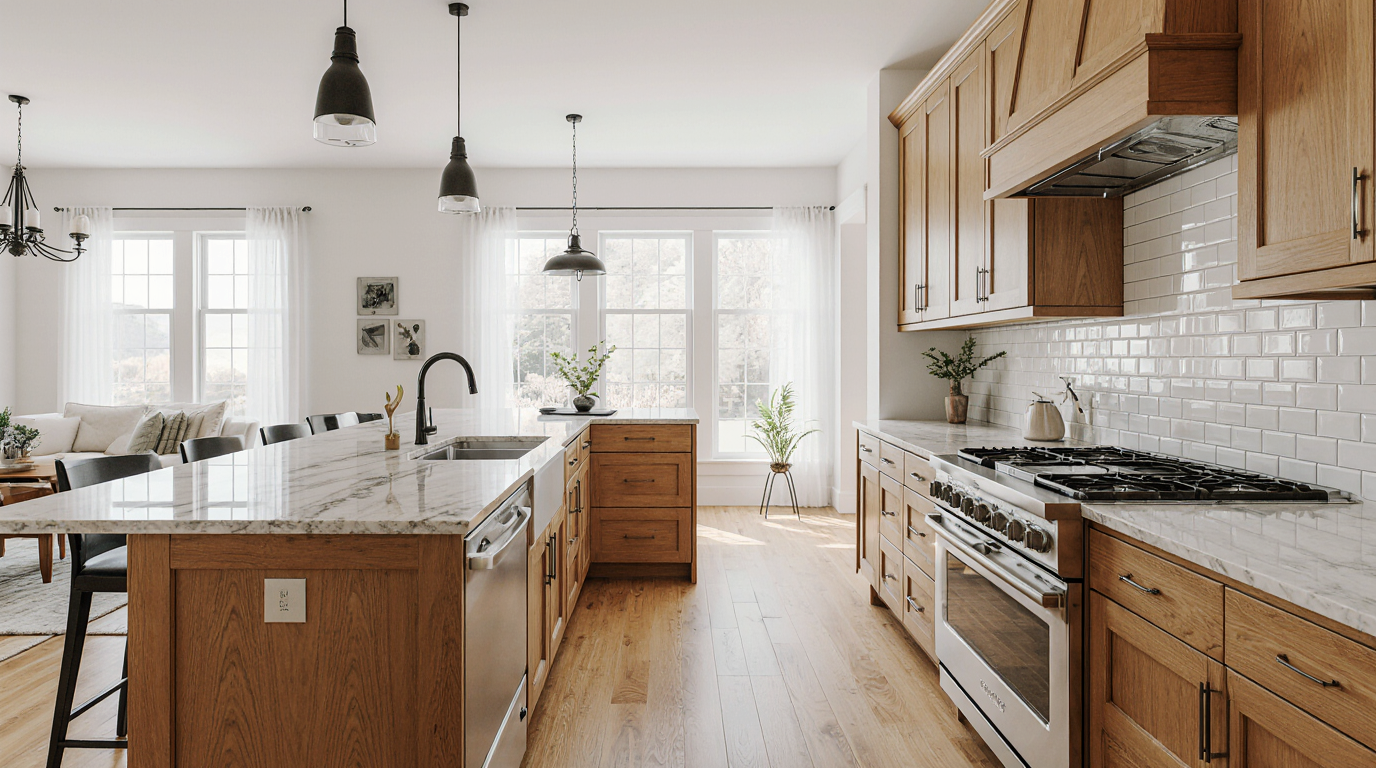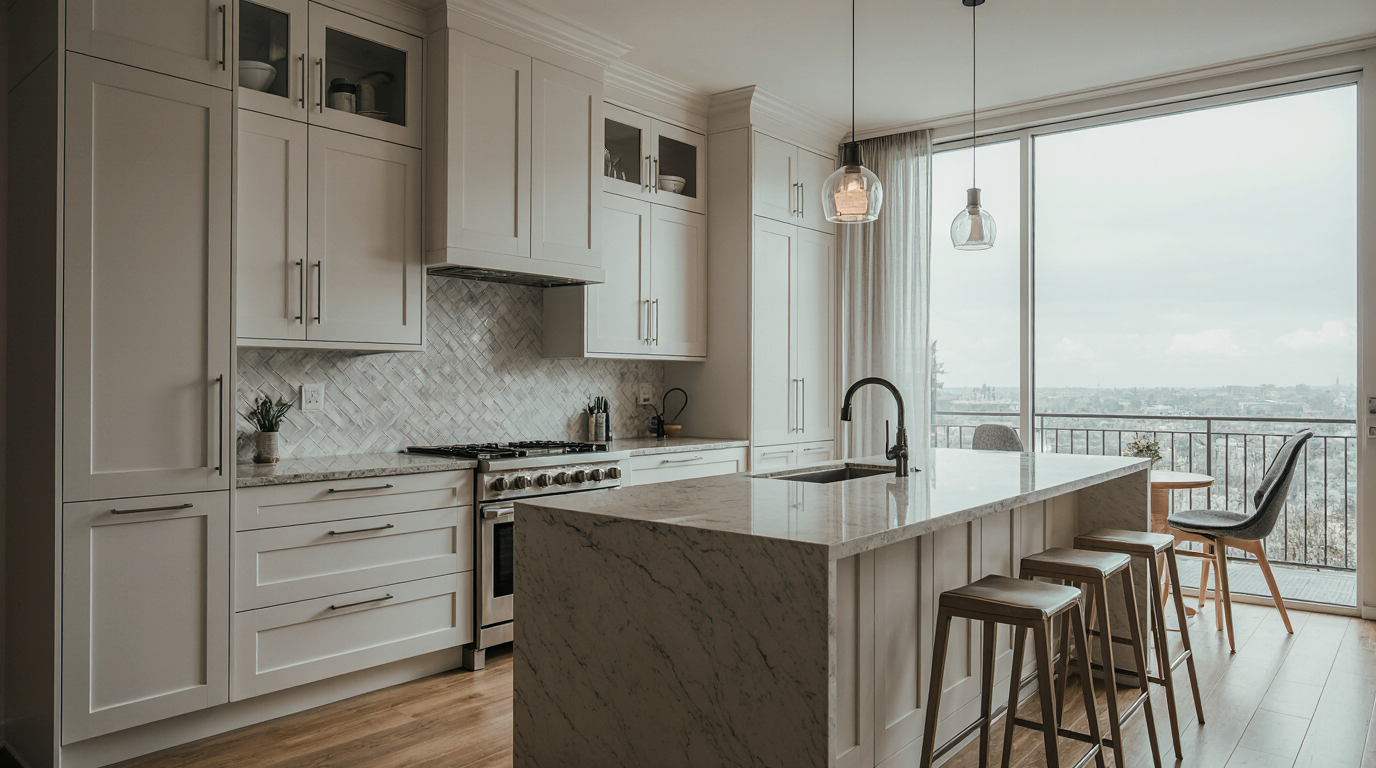
The biggest mistake I see homeowners make with Shaker cabinets in Sarasota isn't about color or hardware; it's assuming the 'solid wood' label guarantees longevity. Here, on the Gulf Coast, a cabinet's survival is determined less by the species of wood and more by the stability of its core material and the resilience of its finish against our relentless humidity. A well-engineered MDF door will often outperform a poorly sealed maple door within two seasons.
Executive Summary: Choosing Shaker Cabinets for Sarasota's Climate
From my 15 years designing and installing kitchens from Longboat Key to Lakewood Ranch, I've learned that Shaker
From my 15 years designing and installing kitchens from Longboat Key to Lakewood Ranch, I've learned that Shaker cabinets here demand a material-first approach. The elegant simplicity of the style creates a large, flat center panel that is uniquely susceptible to expansion and contraction from humidity. The most successful projects prioritize engineered cores for stability and marine-grade finishes over exotic wood species. The focus must be on preventing moisture intrusion from day one, not just achieving a certain look.
- Climate Reality: Sarasota's average humidity levels mean standard cabinet construction can fail. Materials must be specified for high-moisture environments.
- Material Hierarchy: High-Density Fiberboard (HDF) or MDF for painted doors offers superior stability over solid wood, preventing joint cracks in the Shaker frame.
- HOA Compliance: In communities like Lakewood Ranch or The Founders Club, finish and style consistency are key. Pre-approval of samples is a non-negotiable step in the project timeline.
- Finish is Functional: The topcoat is not just for color; it's a vapor barrier. Conversion varnish or catalyzed polyurethane are the standards for our environment.
The Planning Failures That Lead to Warped Doors and Peeling Paint
The most common failures I'm called to fix stem from decisions made before a single cabinet is ordered. Homeowners, often influenced by national trends, select materials and finishes that are simply not engineered for the constant moisture pressure of a Sarasota home, especially one that may sit closed up for part of the year. The aesthetic appeal of a certain wood grain or a specific shade of paint becomes the priority, while the underlying material science is ignored.
The Most Expensive Oversight: Ignoring the Core Material
The costliest mistake is insisting on solid wood for painted Shaker doors. I had a client with a beautiful home on Siesta Key who was adamant about using solid maple for their classic white Shaker kitchen. Despite counsel, they proceeded. Within 18 months, the humidity caused the solid wood center panels to expand, cracking the paint at every single joint on the doors. The repair involved removing all doors, sanding, and repainting — a labor-intensive process that cost nearly 30% of the original cabinet budget and took the kitchen out of commission for weeks.
How a Shaker Cabinet Project Unfolds in Sarasota
A successful project follows a strict sequence, acknowledging our local climate and regulatory hurdles. It begins not with design, but with a deep assessment of the home's environment — its proximity to the water, the quality of its HVAC system, and its usage patterns (full-time residence versus seasonal). This assessment dictates the material specifications that the design must then accommodate. From there, the process moves to detailed shop drawings, material procurement, finishing, and finally, installation.
Key Selection Criteria for Sarasota Homeowners
- Core Material Stability: Prioritize MDF or HDF for painted finishes. For stained wood, insist on quarter-sawn lumber for the rails and stiles and a stable, furniture-grade plywood for the center panel.
- Finish Specification: Request a multi-step finishing process that includes a catalyzed conversion varnish. This provides a harder, more chemically-resistant, and less permeable surface than standard lacquer.
- Hardware Corrosion Resistance: All hardware, including hinges, drawer glides, and pulls, should be specified with stainless steel or a corrosion-resistant finish, especially for homes on the barrier islands.
- Installer's Local Experience: Verify the installer understands how to acclimate cabinetry to the home's environment before installation and uses appropriate fasteners and techniques for concrete block construction common in Florida.
Comparing Shaker Cabinets to Other Local Options
Shaker cabinets are a fantastic choice, but their flat panels and sharp lines make them less forgiving of material movement than other styles. It's crucial to weigh their aesthetic benefits against the material engineering required in our climate. Slab doors or more ornate raised-panel doors can sometimes be more stable or better at hiding minor shifts, respectively.
| Cabinet Style | Humidity Stability | Maintenance Level | Typical Cost Index |
|---|---|---|---|
| Shaker (Engineered Core) | High | Low | 1.1 |
| Slab/Flat Panel (Laminate/Acrylic) | Very High | Very Low | 1.3 |
| Raised Panel (Solid Wood) | Moderate | Moderate | 1.2 |
When Shaker Style Is Not the Right Choice
If your home lacks robust, year-round climate control, or if it's a historic property where maintaining consistent indoor humidity is a challenge, Shaker cabinets can be problematic. The clean lines show imperfections and joint separations clearly. In these specific cases, a frameless cabinet with a high-quality laminate slab door may offer a similar clean aesthetic with far greater dimensional stability and lower long-term risk.
A Safe Hiring Checklist for Your Sarasota Project
Hiring a cabinet maker or supplier in this market requires looking beyond the showroom portfolio. You need to verify their understanding of our specific environmental challenges. A beautiful gallery of work from a different climate zone is not a reliable indicator of success here.
- Ask to see and handle a sample door that has been in their showroom for over a year. Check the joints for hairline cracks.
- Request the specific product data sheet for the finish they use. Confirm it is a post-catalyzed conversion varnish or two-part polyurethane.
- Verify their General Liability and Worker's Compensation insurance is current and compliant with Florida requirements.
- Discuss their process for HOA design review board submissions and ask for examples of approval packages they have prepared for communities like The Lake Club or Lido Shores.
- Confirm they will acclimate the cabinets inside your home for at least 48-72 hours prior to installation.
- For wood cabinets, ask how they source their lumber and if it is kiln-dried to a moisture content suitable for our region (typically 8-10%).
- If you are considering colors like green shaker cabinets or blue shaker kitchen cabinets, ask how the pigments they use perform under intense UV light from large windows.
Decisions That Determine the Final Outcome
The success of your kitchen hinges on a few critical decisions made early in the process. The most important is accepting that in Sarasota, material performance trumps all else. A stunning design executed with inappropriate materials is a failed design. I guide my clients to finalize their material and finish choices first, based on performance, and then build the aesthetic around those constraints. This is the reverse of how most people approach it.
The Exact Moment Most People Get It Wrong
The critical error happens when a homeowner falls in love with a specific shade of paint from a consumer brand and asks the cabinet maker to match it. This often forces the shop to use a product outside their normal, high-performance finishing system. The correct approach is to select your cabinet maker based on their proven finishing system first, and then choose a color from within the palette that system supports. This ensures the chemistry of the finish is not compromised for the sake of a specific color chip.
Practical Answers About Cabinet Projects in Sarasota
Navigating a cabinet project here involves more than just design and installation. You have to contend with local building codes, powerful HOAs, and the logistical realities of construction in a high-demand area. Understanding these bottlenecks is key to a smooth process.
Navigating HOA Design Review in Master-Planned Communities
In communities like Lakewood Ranch, your cabinet style and exterior-facing kitchen window treatments are subject to review. The approval process can add 30 to 60 days to your timeline. You must submit complete documentation, including material samples, color chips, and scaled drawings. Starting any demolition before receiving written approval can result in fines and a stop-work order. It's a formal process that cannot be rushed.
Florida Building Code and Cabinet Installation
While the Florida Building Code (FBC) doesn't dictate cabinet style, it has stringent requirements for how anything is anchored to the wall, especially in coastal and high-velocity wind zones. Your installer must use appropriate fasteners for concrete block walls, and upper or shaker wall cabinet installations must be secured to structural members. This is not a suggestion; it's a structural safety requirement that gets checked during inspections.
The Challenge of Sourcing and Lead Times for Specialty Materials
Demand for high-quality, moisture-resistant materials like marine-grade plywood or specialty HDF is high across Florida. This creates supply chain pressures. Lead times for custom-finished doors can easily stretch from 8 to 16 weeks, particularly during the peak season (October-April). A decision delayed by two weeks in the planning stage can easily result in a one-month delay on the final installation, which is a major disruption for seasonal residents.