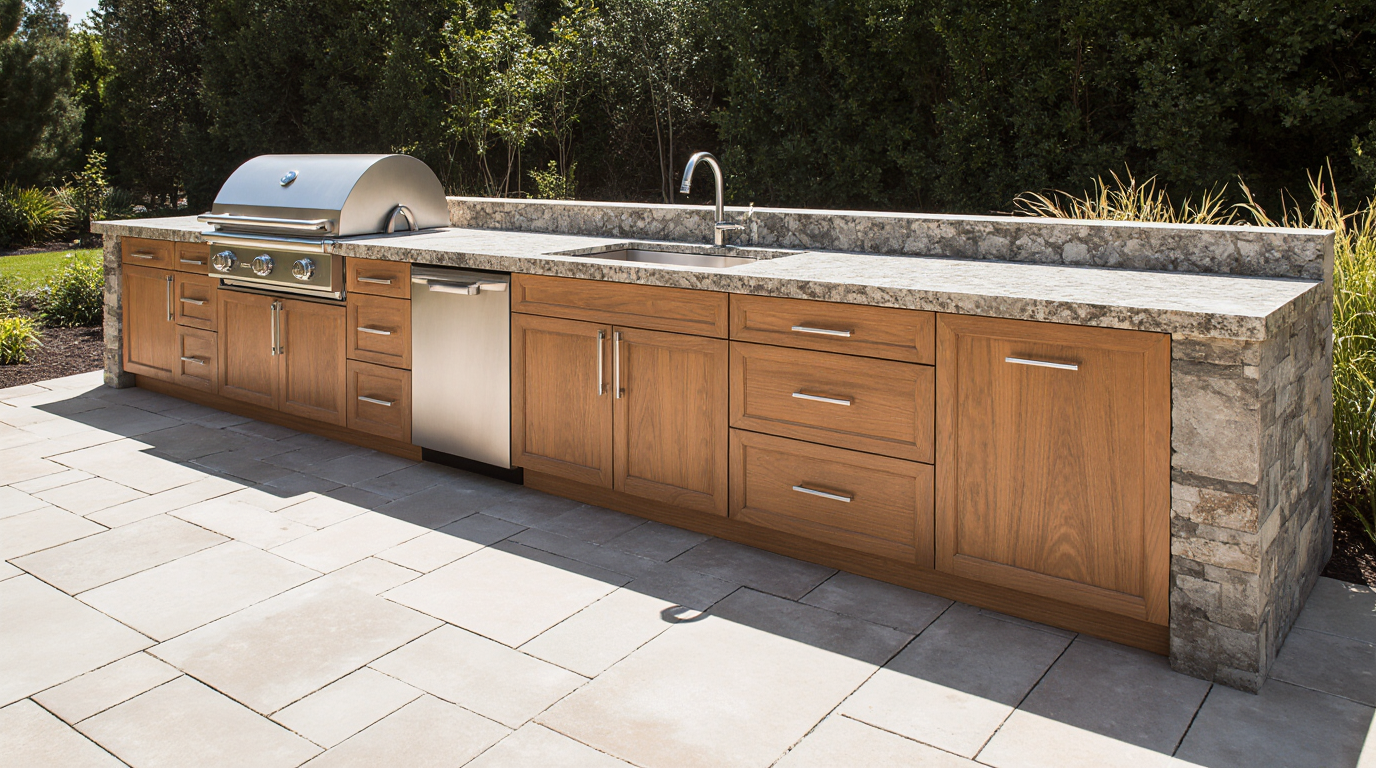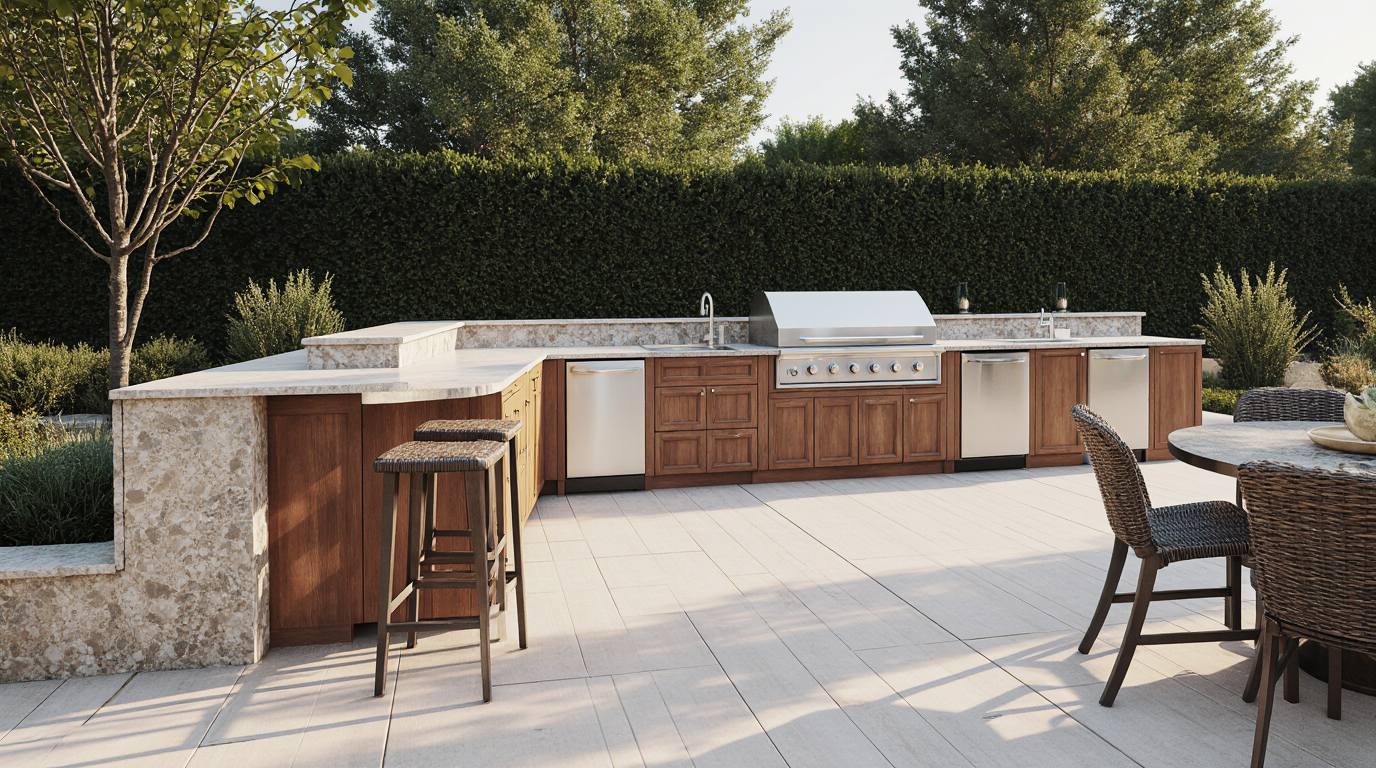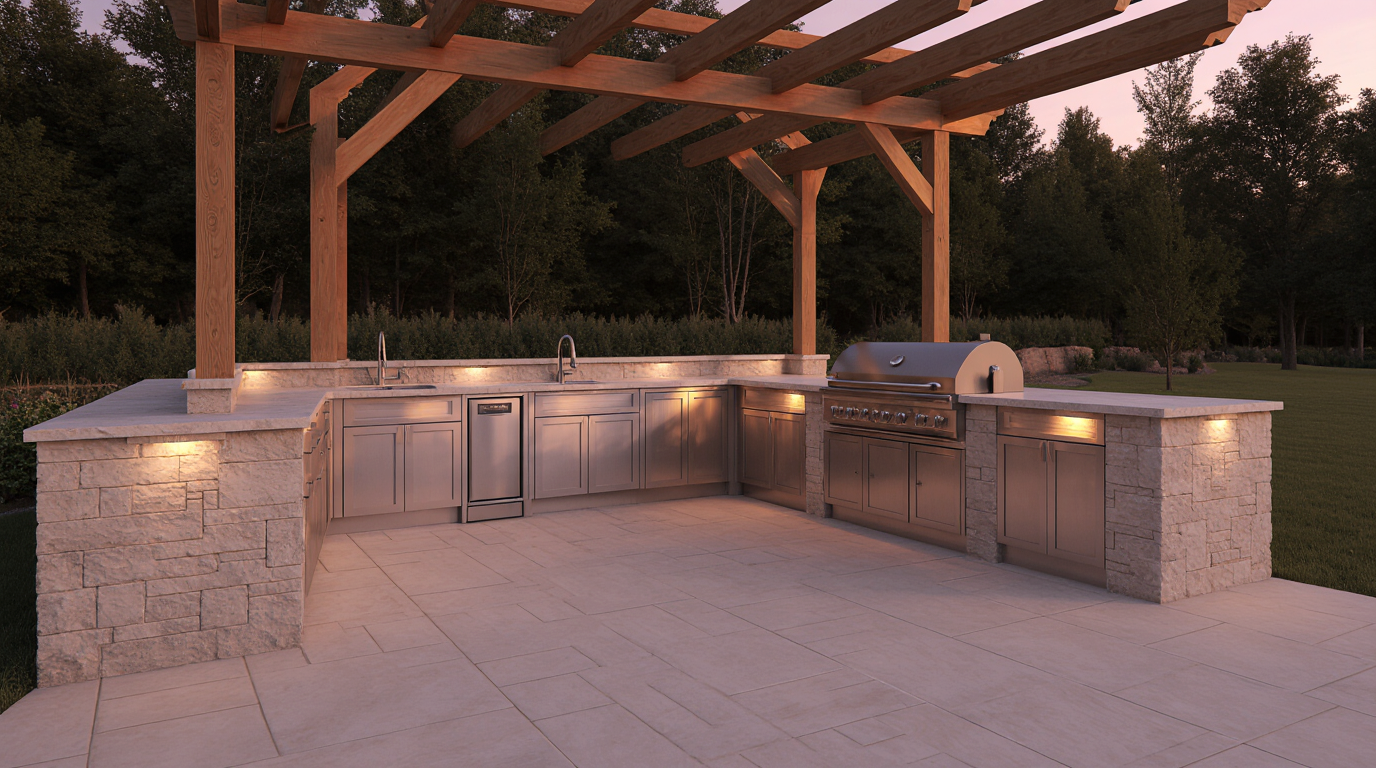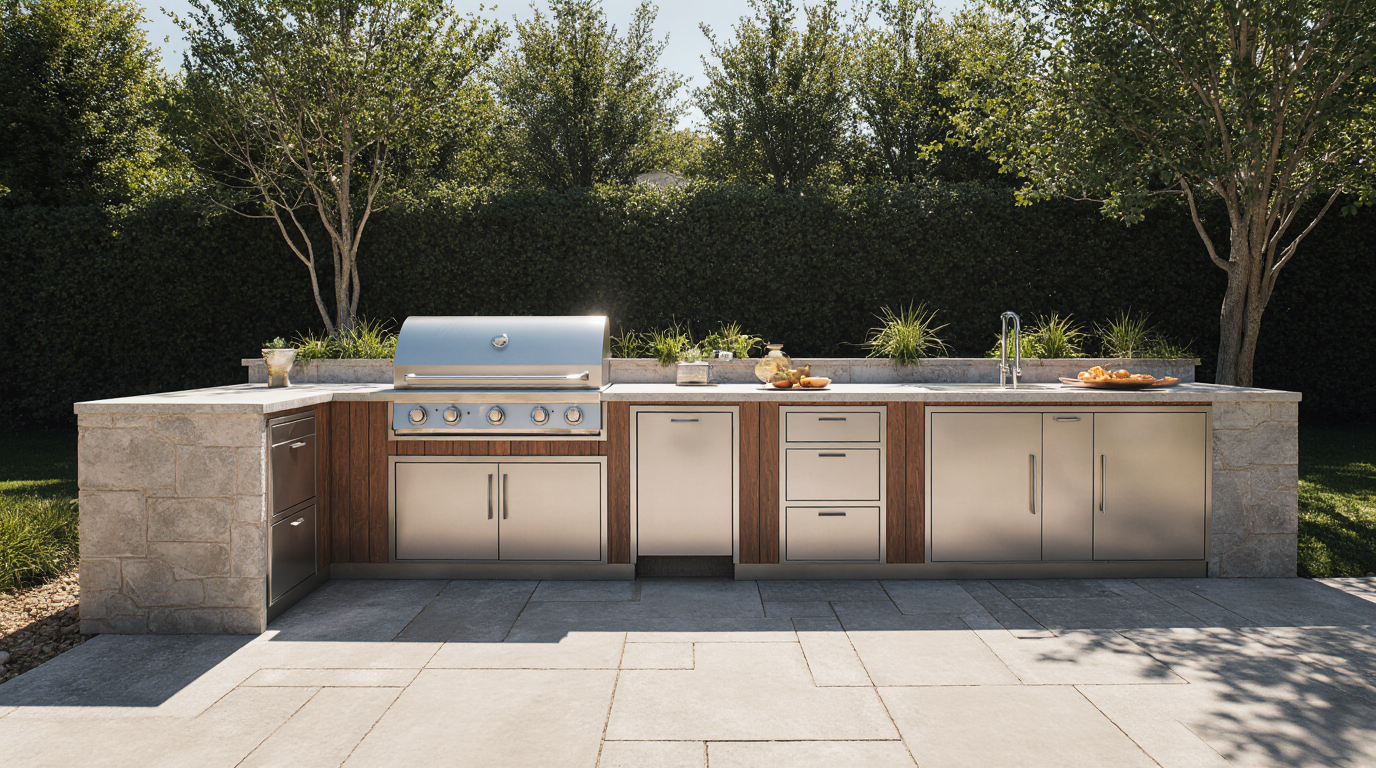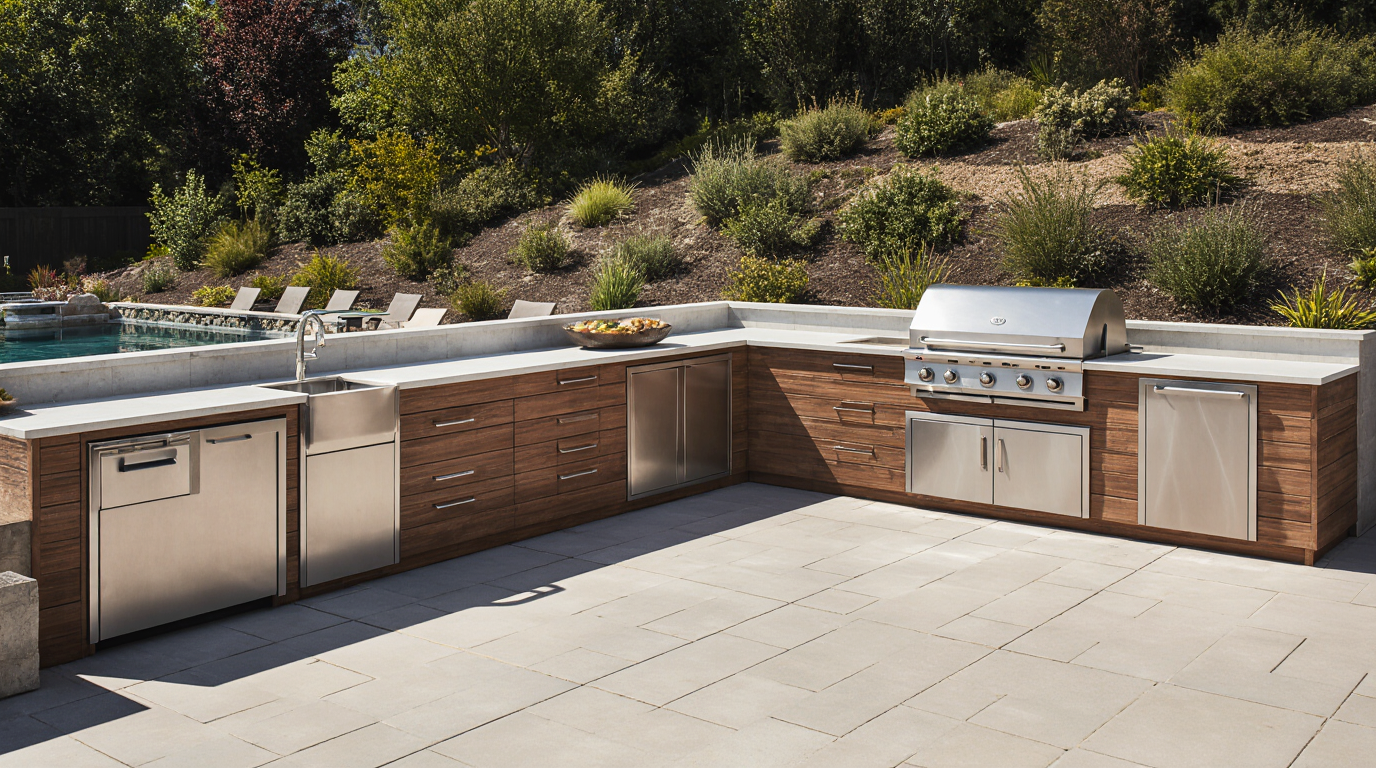
Executive Summary: Modular Outdoor Kitchens in Sarasota
From my direct experience installing outdoor kitchens from Palmer Ranch to Longboat Key, the success of a modular
From my direct experience installing outdoor kitchens from Palmer Ranch to Longboat Key, the success of a modular cabinet system in Sarasota hinges on one factor above all: material science. The convenience and predictable cost of modular units are deeply appealing, but our coastal environment is uniquely unforgiving. I have seen powder-coated steel systems rust from the inside out within three years and PVC units warp under the intense summer sun. The right choice is less about the brand and more about specifying materials engineered for marine environments, even if your property is miles from the bay.
- Material Imperative: Prioritize non-corrosive bases like marine-grade high-density polyethylene (HDPE) or 316-grade stainless steel; 304-grade is insufficient for our salt-laden air.
- HOA Pre-Approval: In communities like Lakewood Ranch or The Founders Club, the HOA design review board's approval process can add 30 to 60 days to your timeline; submit plans early.
- Code-Compliant Anchoring: All permanent outdoor structures must be anchored to meet Florida Building Code wind-load requirements, a detail often overlooked with “freestanding” modular units.
- Utility Planning: Modular systems simplify cabinet installation but not utility runs; gas, water, and electrical lines must be planned and permitted separately with Sarasota County.
The Planning Failures That Undermine Modular Systems
The biggest misstep with modular outdoor kitchens is treating them like indoor furniture—a simple purchase and placement. This thinking ignores the permanent environmental stresses and regulatory requirements of an outdoor installation in Sarasota. A common failure is underestimating the corrosive power of the salt air, even several miles inland. Clients often select a system based on aesthetics, only to see rust stains on their travertine patio within two seasons.
Another critical oversight is neglecting the slab. A modular kitchen needs a perfectly level, properly reinforced concrete pad. Placing heavy units, especially those with stone countertops, on an existing patio slab not engineered for the load can lead to cracking. We've been called to fix kitchens where uneven settling caused cabinet doors to misalign and drawers to jam, a problem that requires dismantling the entire setup to correct the foundation.
The Most Expensive Failure: Ignoring the Countertop Material's Impact
The most costly mistake I consistently see is choosing a countertop material without considering its interaction with the modular cabinet frame. A client in a beautiful Lido Key home chose a stunning, heavy granite slab for their powder-coated aluminum modular kitchen. The frame was rated for the weight, but the installers failed to account for the thermal expansion differential between the dark stone and the metal frame. After one hot summer, the expansion and contraction cycles had warped the frame, popping welds and making it impossible to level the grill insert. The entire system had to be replaced, as the frame's structural integrity was compromised. The initial “savings” on the modular system were dwarfed by the cost of the replacement and reinstallation.
How Modular Installation Works in Practice in Sarasota
A modular outdoor kitchen project in Sarasota is a multi-stage process that goes far beyond simple assembly. It begins with a site assessment to verify that the location has a suitable concrete footing and access to utilities. The design phase involves selecting cabinet boxes, door styles, and appliance cutouts from a manufacturer's catalog, which offers less customization than a fully built-from-scratch kitchen but significantly shortens the design and fabrication timeline.
Once a layout is finalized, we handle the submission of plans to the local HOA for aesthetic approval, which is a mandatory step in most planned communities. Simultaneously, if new gas or electrical lines are required, a licensed contractor must pull the appropriate permits from Sarasota County. The cabinets are then ordered, and upon arrival, the installation team assembles and anchors the units, followed by the countertop and appliance installation by specialized trades.
Selection Criteria for Sarasota Homeowners
- Wind Load Certification: Ensure the manufacturer provides engineering data showing the system, when properly anchored, meets the 150+ MPH wind speed requirements of the Florida Building Code for our region.
- UV-Stabilized Materials: For any polymer or composite cabinets (like HDPE), verify they contain UV inhibitors to prevent fading and brittleness under the intense Florida sun. Ask for the warranty terms specifically covering color stability.
- Hardware Grade: All hinges, screws, and drawer slides must be 316-grade (marine-grade) stainless steel. Anything less, including 304-grade, will show rust spots within a year, especially on the barrier islands.
- Warranty Service Location: Confirm the manufacturer has a responsive, U.S.-based warranty department. When a part fails, you cannot afford to wait weeks for a replacement from overseas, especially mid-season.
Comparison with Alternative Outdoor Kitchens
Modular systems offer a compelling middle ground, but they are not the only option. Homeowners in Sarasota typically weigh them against traditional concrete block (CMU) construction with a stucco or stone veneer finish, and fully custom welded aluminum frames. Each has distinct advantages and disadvantages in our specific climate and market.
| Feature | Modular Cabinet System | Concrete Block (CMU) | Custom Welded Frame |
|---|---|---|---|
| Installation Speed | Fastest (1-3 days on site) | Slowest (3-6 weeks) | Moderate (1-2 weeks on site) |
| Corrosion Resistance | High (with HDPE/316 SS) | Highest (structure is inert) | High (with marine-grade aluminum) |
| Design Flexibility | Limited to catalog sizes | Highest (fully custom shapes) | High (custom built to spec) |
| Cost | Moderate to High | Highest | High |
When a Modular Approach Is Not the Right Choice
A modular system is the wrong path if your primary goal is absolute longevity and perfect integration with complex, high-end architecture. For a legacy waterfront estate, for instance, where the outdoor kitchen is a central feature meant to last for 30+ years and perfectly match the home's stone and archways, a concrete block structure is superior. While more expensive and time-consuming, its permanence and limitless design potential are unmatched. Modular systems, even the best ones, are ultimately a manufactured product with finite design options and a shorter expected lifespan than a masonry build.
Safe Hiring Checklist for Your Sarasota Project
Hiring an installer for a modular outdoor kitchen requires more than just a handyman's skill set. The intersection of cabinetry, utilities, and local building codes demands a specialized professional. Verifying credentials and experience specific to our coastal environment is non-negotiable.
- Verify they are a licensed and insured General or Specialty Contractor in the state of Florida. Ask for their license number (e.g., CGCxxxxxx) and check it on the state's DBPR portal.
- Request photos and addresses of at least three completed projects in Sarasota County that have been through at least two summer/hurricane seasons.
- Confirm they will be responsible for pulling all necessary permits for electrical and gas work, not leaving it to you or a subcontractor you have to manage.
- Ask specifically how they anchor their cabinet systems to meet the Florida Building Code's wind uplift requirements and what fasteners they use for a concrete slab.
- Inquire about their process for coordinating with your community's Architectural Review Board or HOA, as they should be familiar with the submission requirements for major local developments.
- Get a detailed scope of work that specifies the brand and material grade (e.g., “316 stainless steel,” “marine-grade HDPE”) for all components, including hardware.
- Ensure the contract includes a clear timeline that accounts for potential HOA approval delays.
Decisions That Determine the Final Outcome
The success of a modular outdoor kitchen project is determined long before the first cabinet is unboxed. The most crucial decision, from my perspective, is committing to a layout that prioritizes function and durability over cramming in every possible feature. An outdoor kitchen is a workspace exposed to the elements. Good design in Sarasota means ensuring proper ventilation for the grill, adequate clearance from flammable wall materials, and a layout that minimizes exposure to the prevailing sea breeze where possible.
I’ve seen clients insist on a layout that looks great on paper but is impractical in reality—like placing a sink too far from the grill or an outdoor refrigerator in direct, all-day sun, forcing it to run constantly and fail prematurely. The best outcomes result from a collaboration where the homeowner's vision is guided by a professional's understanding of our local environmental realities.
The Exact Moment the Majority Gets It Wrong
The most common critical error happens during the material selection phase. Homeowners are presented with a “good, better, best” scenario, often framed around cost. The mistake is choosing the “better” option—typically powder-coated galvanized steel or 304-grade stainless—to save a few thousand dollars. In a climate like ours, this is a false economy. The salt, humidity, and UV radiation will degrade these mid-tier materials, leading to failure in 3-5 years. The correct decision is to always specify the “best” materials—marine-grade polymer (HDPE) or 316-grade stainless steel—from the outset. The upfront cost is higher, but it's the only choice that avoids a complete tear-out and replacement well before you expect it.
Practical Answers About Operations in Sarasota
Navigating HOA and ARB Design Reviews
Almost every planned community in the Sarasota area, from University Park to Casey Key, has a strict Architectural Review Board (ARB) or HOA design committee. For a modular outdoor kitchen, you must submit a complete package including a site plan showing the kitchen's location, dimensioned drawings of the layout, and material/color samples. A common bottleneck is incomplete submissions. We ensure our clients' packages include everything upfront to avoid the typical 30-day delay cycle. Failure to get approval before work starts can result in fines and a stop-work order.
Understanding Permit Requirements for Utilities
Simply assembling cabinets on a patio does not require a permit. However, the moment you connect a gas grill to a permanent line, install an outdoor-rated refrigerator, or run a water line to a sink, you trigger the need for permits from Sarasota County Planning and Development Services. A licensed electrician must pull an electrical permit, and a licensed plumber or gas-fitter must pull permits for their respective work. Attempting to bypass this process can create significant liability issues and problems when you eventually sell your home.
Addressing Flood Zone and Elevation Requirements
For homes in designated flood zones, particularly on the barrier islands like Siesta or Longboat Key, there are specific regulations regarding outdoor installations. All electrical outlets must be raised above the Base Flood Elevation (BFE) established by FEMA. Furthermore, any permanently installed equipment, like a grill or refrigerator, may also need to be elevated. We always cross-reference a property's address with the latest FEMA flood maps to ensure the design and installation are fully compliant, preventing future insurance or code violation issues.