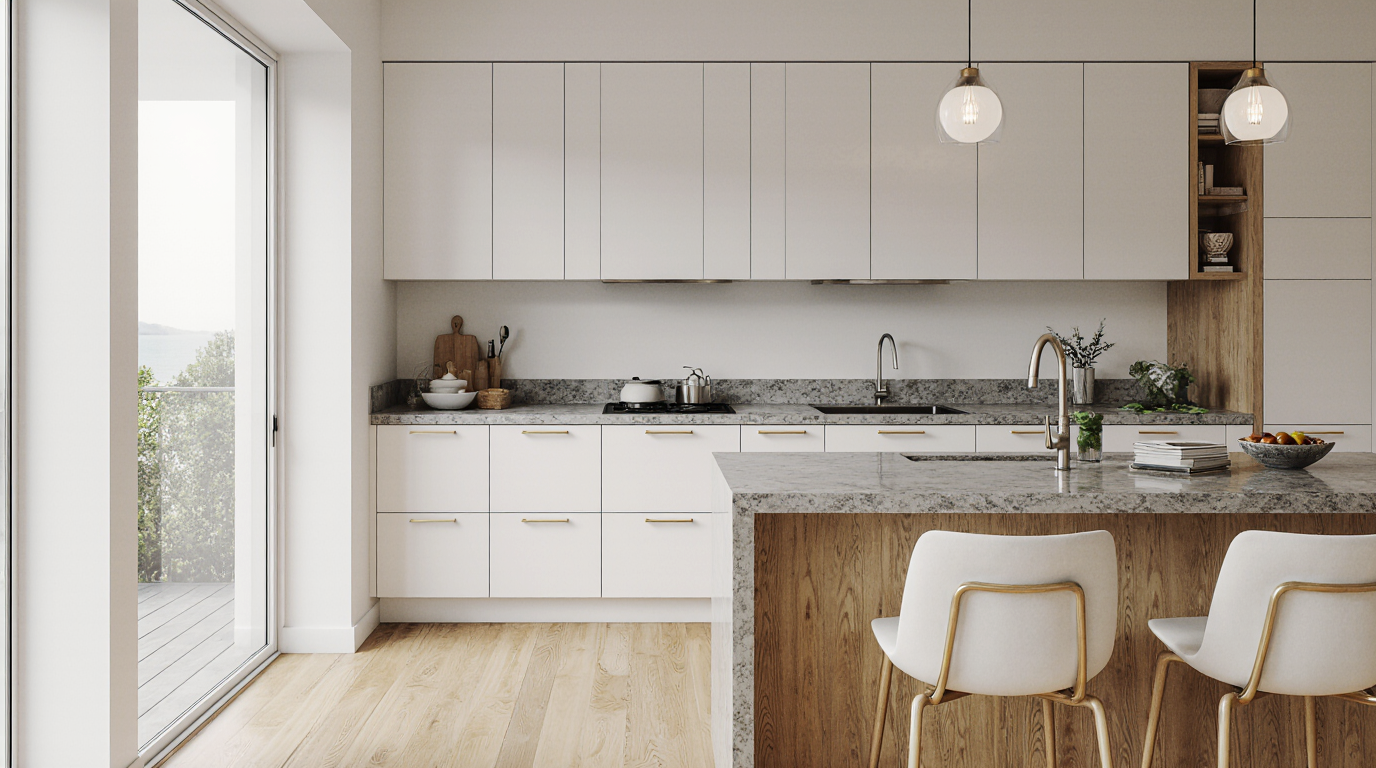
Executive Summary of Modern Shaker in Sarasota
From my direct experience installing high-end kitchens in Sarasota, the success of a modern Shaker cabinet project
From my direct experience installing high-end kitchens in Sarasota, the success of a modern Shaker cabinet project hinges less on the brand and more on its material specification against our coastal climate. The clean, minimalist lines of modern Shaker design are unforgiving; any warping or finish failure from humidity becomes immediately obvious. The core challenge is achieving that sleek aesthetic with materials and construction methods that guarantee stability in a high-moisture environment, something standard off-the-shelf options often fail to deliver within a few seasons.
- Core Material is Non-Negotiable: The cabinet box foundation must be marine-grade plywood or a high-density furniture board specifically engineered for moisture resistance.
- Finish System Matters Most: A catalyzed conversion varnish or a 2K polyurethane finish is the minimum standard for durability against humidity and UV exposure.
- HOA Pre-Approval is Critical: In communities like Lakewood Ranch or Palmer Ranch, the design review process can add 30-60 days to a project timeline; material and color samples are often required upfront.
- Hardware Must Be Marine-Grade: Salt air corrodes standard hardware quickly. Specifying 304 or 316-grade stainless steel for pulls and hinges is a necessary long-term investment.
The Planning Failures That Compromise Modern Shaker Kitchens
The most frequent and costly mistakes I see in Sarasota kitchen remodels happen long before the first cabinet is installed. They are errors in specification, driven by an understandable focus on the visual aspects—color, door style, countertops—while overlooking the structural and environmental realities of our location. A classic example is prioritizing solid wood for doors without understanding its limitations here.
A common pattern involves clients falling in love with a particular wood shaker cabinet style they saw in a national design magazine. They insist on solid wood rails and stiles for authenticity, not realizing that the wide temperature and humidity swings in a Sarasota home, especially a part-time residence, can cause those beautiful solid wood joints to expand and contract, leading to hairline cracks in the paint finish within a year or two. The modern look, particularly with painted finishes like a deep blue or crisp white, relies on perfect, seamless surfaces that make these failures highly visible.
The True Cost of Ignoring Humidity in Material Selection
The single most expensive failure is specifying standard MDF or particleboard for cabinet boxes to save on the initial quote. I was called into a project on Bird Key where the homeowner had done just that. Six months after installation, the under-sink cabinet base had swelled and delaminated from a minor plumbing leak, and the toe-kicks in the high-traffic kitchen area were showing similar signs of moisture absorption just from mopping the floor. The fix required a complete tear-out of the lower cabinets, costing nearly 70% of the original installation price and putting their kitchen out of commission for weeks. This is a direct consequence of not investing an extra 15-20% upfront for marine-grade plywood or moisture-resistant cores.
The Practical Process for a Resilient Installation
A successful modern Shaker cabinet project in Sarasota follows a distinct process adapted to our local conditions. It moves beyond simple design and measure to incorporate rigorous material vetting and environmental planning. The process begins not with a layout, but with a conversation about how the home is used—is it a full-time residence with stable climate control, or a vacation property that sits closed for months? The answer dramatically changes the material recommendations.
From there, we move to detailed shop drawings that specify not just dimensions but also the exact core materials, finish schedules, and hardware grades. These drawings are what get submitted to the necessary bodies—whether it's the City of Sarasota Building Department for permit review if structural changes are involved, or the local HOA design committee for aesthetic approval. Only after these approvals are secured does fabrication begin.
Key Selection Criteria for Sarasota Homeowners
- Ask for Core Material Samples: Don't just look at door samples. Request a cross-section of the cabinet box material. You should be able to see the multi-ply construction of marine-grade plywood versus the particle composition of standard board.
- Verify the Finish Specification: The proposal should explicitly name the finishing product (e.g., “Catalyzed Conversion Varnish”). Vague terms like “durable finish” are a red flag.
- Confirm Hurricane Code Compliance: For any shaker wall cabinet, especially on exterior walls, the installer must use anchoring methods compliant with the Florida Building Code's wind load requirements. Ask to see the fastener schedule on the plans.
- Check the Fabricator’s Local Portfolio: Ask to see and speak with owners of kitchens they installed in Sarasota (specifically on the water, if applicable) more than three years ago. This is the best proof of their work's durability.
How Modern Shaker Compares to Other Local Options
In the Sarasota market, homeowners often weigh modern Shaker cabinets against two other popular choices: high-gloss European-style slab doors and traditional raised-panel wood cabinets. Each has distinct advantages and disadvantages tailored to our coastal environment and lifestyle. The decision often comes down to a trade-off between aesthetic preference, maintenance tolerance, and budget.
Modern Shaker occupies a versatile middle ground. It offers more warmth and texture than sterile high-gloss styles but is cleaner and more contemporary than traditional designs. However, its recessed center panel can be a collection point for dust and grime, requiring slightly more maintenance than a simple slab door.
When a Modern Shaker Style Isn't the Right Choice
Despite its popularity, the modern Shaker style is not the ideal choice for every situation. If a homeowner’s primary goal is the absolute lowest maintenance possible, a high-quality, thermally-fused laminate slab door is superior. The seamless, non-porous surface has no joints or recesses to collect dirt or moisture, making it incredibly easy to clean and highly resistant to the humid Sarasota climate. For a rental property or a high-use beach house where durability and ease of cleaning trump nuanced design, I often guide clients toward this more utilitarian, albeit less detailed, option.
| Feature | Modern Shaker (with proper specs) | High-Gloss Slab (European Style) | Traditional Wood Raised-Panel |
|---|---|---|---|
| Humidity Resistance | Excellent (with marine-grade core & premium finish) | Superior (seamless, non-porous surface) | Fair to Good (prone to joint expansion/contraction) |
| Maintenance | Moderate (recessed panels collect dust) | Low (easy to wipe clean, but shows fingerprints) | High (complex profiles are difficult to clean) |
| Aesthetic Versatility | High (transitional, fits many styles) | Low (strictly contemporary/modern) | Low (strictly traditional) |
A Safe Hiring Checklist for Sarasota Projects
Hiring a cabinet maker or installer in Florida requires more than just reviewing a portfolio. Our state has specific licensing requirements and our environment has unique material demands. This checklist is designed to protect your investment and ensure a lasting, high-quality result.
- Verify Florida Contractor License: Ensure the installer holds a valid, current license with the Florida Department of Business and Professional Regulation (DBPR). Ask for their license number and verify it online.
- Request Proof of Liability and Workers' Comp Insurance: Do not proceed without seeing a Certificate of Insurance. If an uninsured worker is injured on your property, you could be held liable.
- Demand Marine-Grade Plywood Specification: The contract must explicitly state that cabinet boxes will be constructed from marine-grade plywood (e.g., BS 1088 standard) if you are near the water or want maximum durability.
- Review HOA Submission Protocol: Ask about their experience with your specific HOA (e.g., The Founders Club, Prestancia). An experienced local firm will know the submission requirements and key contacts, preventing costly delays.
- Get a Detailed Finish Schedule: The contract should detail the entire finishing process, including the number of primer and top coats and the specific chemical composition of the finish (e.g., 2K Polyurethane).
- Clarify Warranty Terms on Finish Failure: A quality warranty should cover finish failures like peeling or cracking due to humidity for at least 5 years. Standard warranties often exclude environmental factors.
Decisions That Determine the Final Outcome
After overseeing dozens of kitchen projects in this area, I can pinpoint the decisions that truly separate a satisfactory outcome from an exceptional one. The most critical choice is committing to the right infrastructure for your cabinets before obsessing over the final color. It’s an issue of prioritizing the unseen—the box construction, the finish, the hardware—over the immediately visible.
Another pivotal moment is the hardware selection. A client might choose beautiful brass pulls for their new blue shaker kitchen cabinets, but if it’s not PVD coated or solid, unlacquered brass meant to patina, the salt air on Casey Key will have it pitting and corroding in under a year. The right decision is to allocate a realistic part of the budget to high-grade, corrosion-resistant hardware from the start, rather than treating it as a final decorative touch.
The Exact Moment Most Homeowners Get It Wrong
The critical error happens during the bid comparison stage. Most people lay three quotes side-by-side and are immediately drawn to the lowest number, assuming the line item “Custom Shaker Cabinets” means the same thing from all three providers. It never does. They get it wrong when they fail to ask: “What specific materials and finishes are you quoting to justify this price?” A lower price almost always means a lower-grade core material, a less durable finish, or cheaper hardware. The single most important action is to force an apples-to-apples comparison by providing your own minimum specification sheet to all bidders, requiring them to quote based on a marine-grade plywood box and a catalyzed conversion varnish finish. This reveals the true cost of quality.
Practical Answers About Operations in Sarasota
Navigating a cabinet project involves more than design; it requires an understanding of local regulations and logistics. These are the operational hurdles where projects in Sarasota can get stalled or encounter unexpected costs.
Handling HOA Design Reviews in Planned Communities
In master-planned communities like Lakewood Ranch, the Homeowners Association (HOA) design review board has final say on any exterior-facing modifications, which can sometimes include windows being altered for a kitchen remodel. For interior-only projects, the process is simpler, but a full renovation often requires submitting plans, material samples, and color swatches. A typical review cycle takes 30 days, but if the board requests revisions, it can easily stretch to 60 days. It's crucial to start this process immediately after finalizing the design, well before scheduling demolition.
Permitting for Kitchen Remodels with the City of Sarasota
If your kitchen remodel involves moving walls, altering plumbing, or changing electrical layouts, a building permit from the City of Sarasota is required. The plan review process currently averages between 4 to 6 weeks for a standard residential project. This timeline must be factored into the project schedule. Attempting to do this work without a permit can result in stop-work orders, fines, and significant difficulty when you eventually sell the property. The permit fee itself is a small part of the budget, often just a few hundred dollars, but the cost of non-compliance is substantial.
Florida Building Code and Cabinet Anchoring
The Florida Building Code (FBC) has stringent requirements for how elements are secured to a structure, particularly in High-Velocity Hurricane Zones (HVHZ), which includes coastal Sarasota. While kitchen cabinets aren't a primary structural element, the code dictates anchoring requirements for wall cabinets to ensure they do not detach during a storm event. This means your installer must use specific types of fasteners at specified intervals, screwed directly into studs. Simply using standard drywall anchors is non-compliant and unsafe. A knowledgeable installer will address this as a standard practice, but it's something homeowners should confirm.