
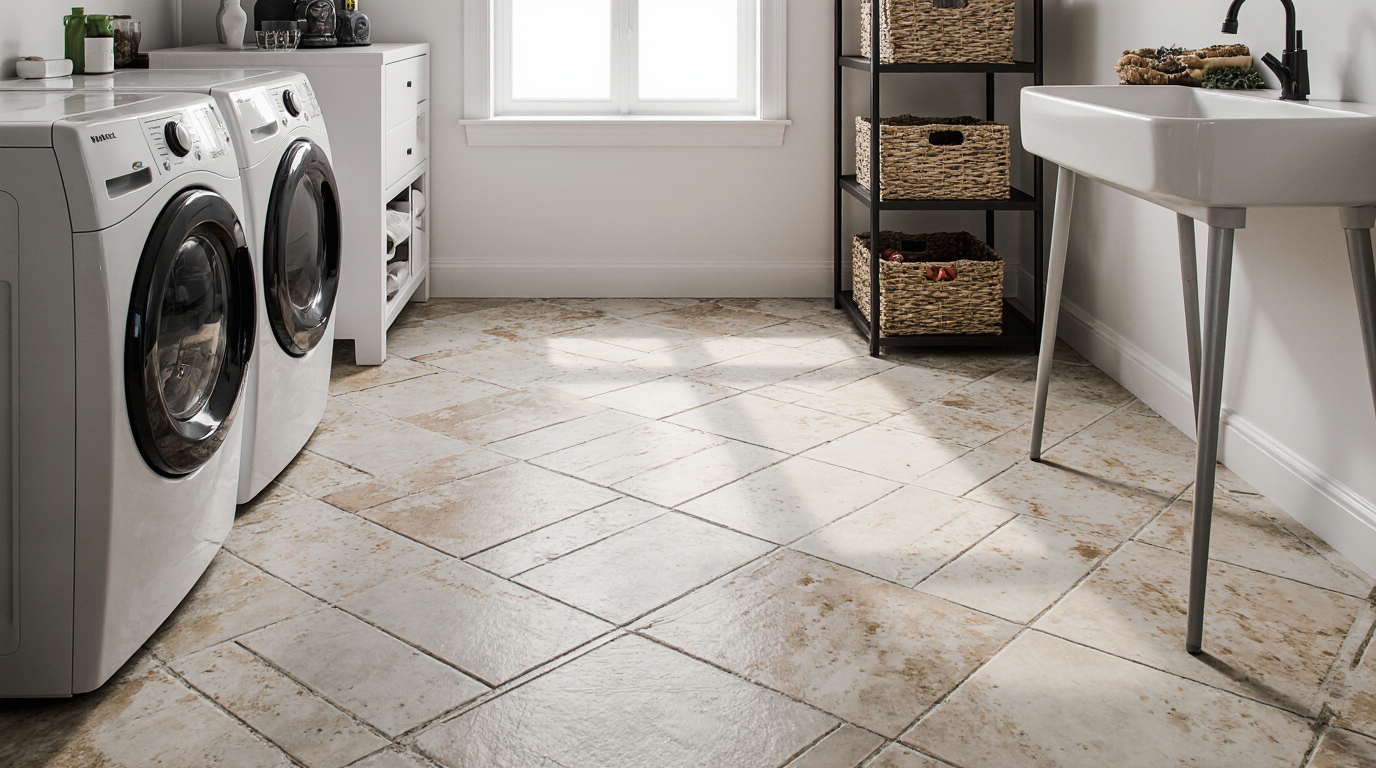
The laundry room floor is arguably one of the most demanding surfaces in the entire home. It must simultaneously withstand the constant vibration and significant weight of heavy appliances, repel the caustic nature of cleaning agents and laundry chemicals, be ready for the inevitable accidental spill or hose failure, and, increasingly, contribute meaningfully to the home's overall aesthetic. Selecting the appropriate tile is paramount to achieving a space that is both beautiful and brutally functional. As an expert in Laundry Room Design, I emphasize that the flooring decision moves far beyond mere color preference; it is a material science choice that dictates longevity and ease of maintenance.
When it comes to high-performance utility flooring, porcelain tile stands out as the premier choice. This material is manufactured from refined clay fired at extremely high temperatures, yielding a final product that is remarkably dense with a minimal absorption rate. This low water absorption rate—often less than $0.5\%$—makes it inherently water-resistant, a critical characteristic for any area where plumbing fixtures are present and minor floods are a possibility. Furthermore, porcelain offers superior durability and resilience against chipping and cracking, creating a rigid, reliable foundation capable of supporting heavy, vibrating equipment without any risk of bending or failing, unlike some softer materials. The finished surface naturally shrugs off stains caused by common cleaning agents, ensuring that the inevitable drop of bleach or stain remover does not result in a permanent eyesore. Contemporary porcelain offers truly stunning aesthetic flexibility; you can replicate the elegant appearance of authentic marble or granite, the warmth of wood-look planks, or capture the industrial chic of poured concrete surfaces—without sacrificing any of the material's unparalleled practical benefits.
Although porcelain leads the pack, ceramic tile is still a viable, and frequently more economical, option. Ceramic tiles are also water-resistant and easy to clean, but they are generally less dense and slightly more porous than their porcelain counterparts. For a laundry room that experiences only moderate use, high-quality, well-installed ceramic can suffice, though one must consider that repeated, prolonged water exposure over many years might eventually lead to problems. To maximize the performance of any tile in this environment, the grout selection and application become a secondary, yet critical, layer of defense. It is absolutely essential to select an epoxy-based grout or a premium cementitious version that is properly sealed; this is an industry standard. Sealing prevents moisture, dirt, and laundry residues from penetrating the porous grout lines, which are often the weak point in a tiled floor system, making the daily cleaning process dramatically easier.
In terms of aesthetics, the dimensions and layout of the tiles determine the room's apparent size and overall feel. For modern, streamlined aesthetics, large-format porcelain tiles (such as $24 \times 24$ inches or larger planks) are highly recommended. The primary benefit here is the significant reduction in grout lines—fewer breaks create a much cleaner, more expansive appearance that is naturally simpler to maintain. Minimizing the grout lines results in less upkeep and a polished, uninterrupted aesthetic, particularly when the grout is perfectly matched to the tile color.
Those looking to make a bold statement will find that decorative, patterned tiles are an excellent choice. Encaustic-look porcelain tiles, often featuring rich geometric or Moroccan-style designs, allow the functional utility room to transform into a design showcase. A hidden benefit of these complex designs is their superior ability to hide stray fibers, dust, and small marks between regular cleanings. A checkerboard pattern—whether classic black and white or a softer neutral pairing—provides a timeless, vintage vibe that pairs beautifully with both contemporary and traditional cabinetry. With detailed geometric designs, it's vital to assess how the size of the pattern interacts with the overall dimensions of the room; a design that seems well-proportioned in a large display might feel too cluttered and dizzying in a small room. In these instances, designers often restrict the bold pattern to the floor only, keeping walls and backsplashes serene and neutral to maintain design equilibrium.
Another compelling tile concept revolves around texture and slip resistance. Where the risk of standing water from a leak or an overflow is present, safety should be the top priority. Highly polished or glossy finishes are often relegated to wall applications where footing is not a concern. For flooring, a matte finish or a tile with an inherent texture—such as slate-look porcelain or wood-look tiles with a slight grain texture—provides a higher coefficient of friction ($\textCOF$), enhancing slip resistance when the floor is damp. Small, textured mosaic tiles, benefiting from the many grout lines that act as tiny slip-resistant barriers, are also a fantastic, though more complex to install, choice.
The selection of the floor's color is also a strategic decision. A brilliant white color provides a pristine, sharp appearance, but it immediately highlights every speck of dirt. Mid-to-dark-toned grouts are the authority's choice for high-traffic utility areas, as they effectively mask everyday dirt and require less frequent deep cleaning compared to white grout. Using brick-format porcelain in a sophisticated herringbone pattern with a dark grout can evoke the durable charm of a traditional industrial space, all while delivering cutting-edge performance. If the goal is an airy, expansive feel, light greys, soft taupes, or off-whites provide brightness without the stark maintenance demands of pure white. By carefully blending the technical aspects of material selection—opting for ultra-dense porcelain—with thoughtful design decisions—such as the size of the pattern and the shade of the grout—the flooring in the laundry room can rise above its purely functional purpose to become a key foundation for a practical and beautiful home environment.



