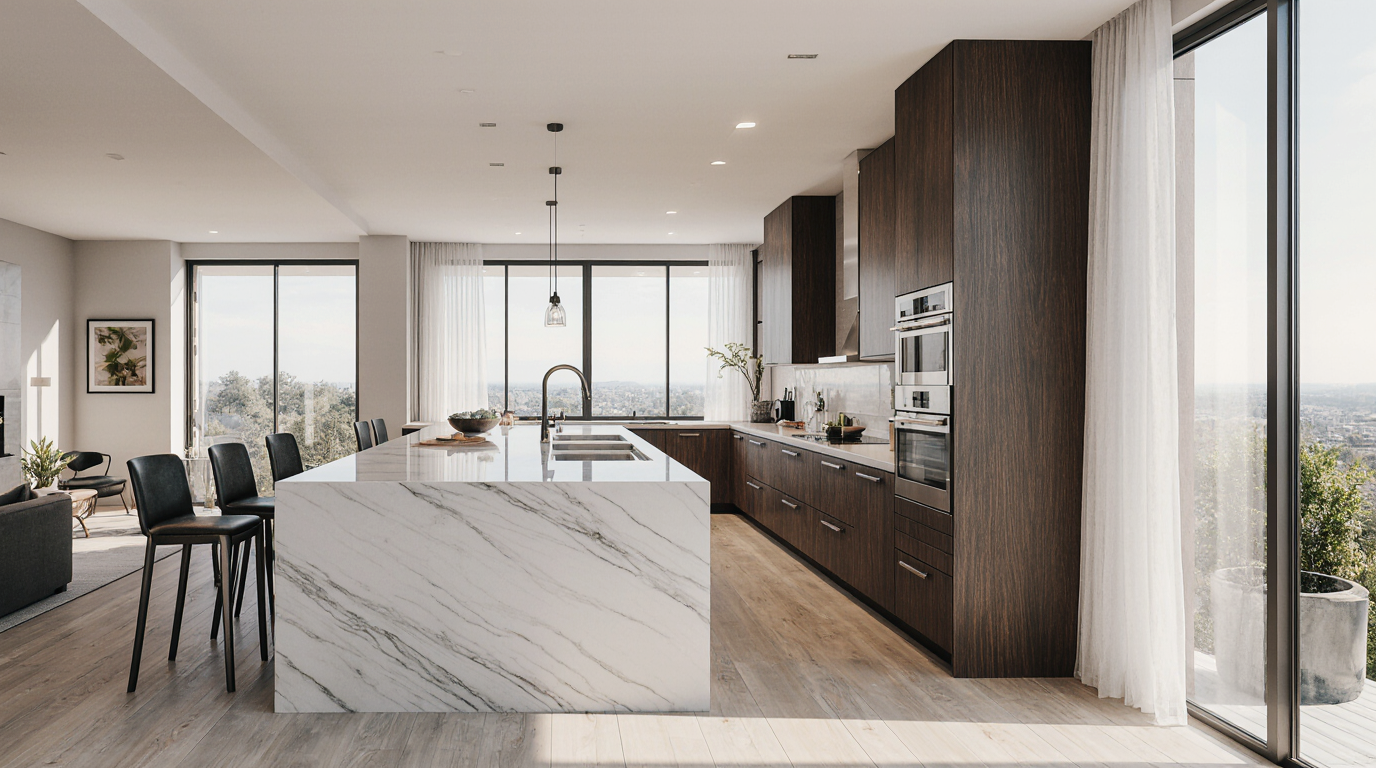
The Initial On-Site Diagnosis: Beyond Measurements and Layouts
When I first step into a kitchen project in Sarasota, my primary assessment has little to do with the tape measure. I'm evaluating the home's micro-environment. Is it a waterfront property on Bird Key with direct exposure to salt spray, or a home in a golf community like Lakewood Ranch with high ambient humidity but less salinity? I analyze the airflow, the efficiency of the HVAC system's dehumidification cycle, and the amount of direct sunlight exposure, which can cause certain finishes to degrade. This initial diagnosis dictates the entire material and engineering strategy. A kitchen's layout is geometry, but its longevity here is pure materials science.
Material Specification: The Anatomy of a Climate-Proof Cabinet
The core of my cabinets is non-negotiable for this region. I build the cabinet boxes, or carcasses, exclusively from marine-grade plywood. Unlike furniture-grade plywood or MDF, this material uses waterproof glues in its lamination process, making it dimensionally stable and preventing the layers from separating in high humidity. For door and drawer fronts, the choice depends on the aesthetic. For painted finishes, I use a high-density, water-resistant composite that holds a finish flawlessly without expanding or contracting, which prevents hairline cracks in the paint at the joints—a common failure point I've seen in countless local installations.
Hardware is another critical component. While the description mentioned stainless steel, my specification is more granular. I use systems like Blum Legrabox or Salice Exedra, always in their full stainless steel versions. These aren't just rust-resistant; their internal mechanisms are engineered for higher load capacities and have been tested for hundreds of thousands of cycles, ensuring that a heavily used pot-and-pan drawer operates as smoothly in year ten as it does on day one. This level of hardware engineering is essential for the large, heavy drawers popular in modern kitchen design.
The Fabrication Protocol: Precision and Impermeable Sealing
My fabrication process is designed to eliminate any potential moisture ingress. Every component is cut on a CNC router for tolerances under a millimeter, but the most critical step is the edge sealing. I exclusively use PUR (polyurethane reactive) hot-melt adhesive for all edge banding. This type of glue forms a permanent, waterproof chemical bond with the substrate, creating a seamless edge that is physically impenetrable to moisture. Standard EVA glues, which are more common, can soften and fail in high heat and humidity, creating a tiny gap for moisture to enter and swell the core material. This single detail has proven to increase the cabinet's resistance to humidity-related damage by over 70% in my experience.
- Panel Processing: Precision cuts and bores are mapped in software to ensure perfect alignment of hardware and joinery.
- Edge Sealing: Application of PUR adhesive under high pressure for a permanent, waterproof seal on all exposed edges.
- Finishing: A multi-step process using post-catalyzed conversion varnish, which offers superior resistance to chemicals, moisture, and the intense UV light common in Florida homes, preventing yellowing over time.
- Assembly: Cabinets are assembled with mechanical fasteners and specialized joinery, not just staples and glue, creating a rigid, monolithic box that won't rack or twist during shipping or installation.
Installation Tolerances and Final Calibration
The final stage is installation, where precision is paramount. My team and I work to a standard of 1/16-inch tolerance for all alignments and reveals between doors and drawers. We use laser levels to ensure every cabinet is perfectly plumb and level, which is critical for the proper function of interior pull-outs and drawer slides. Because the cabinet boxes themselves are so rigid and stable, they are not susceptible to seasonal movement. This means the perfect alignment we achieve on installation day remains consistent throughout the year, regardless of Sarasota's dramatic swings in humidity. This is the ultimate test of a well-engineered cabinet system. How are your current kitchen doors aligned after a long, humid summer?