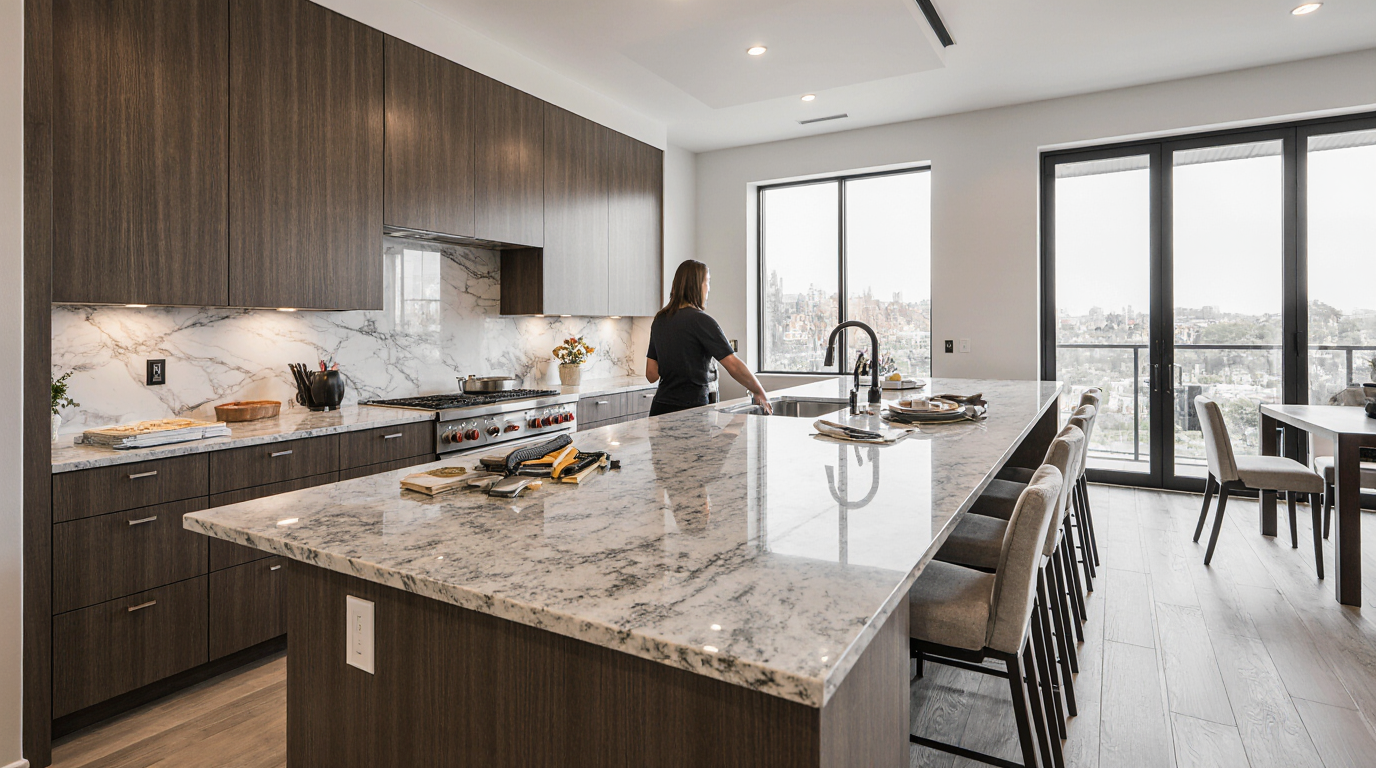
Executive Summary: Your Sarasota Countertop Project
From my years managing renovations from Siesta Key to The Meadows, I've seen firsthand how Sarasota’s climate dictates
From my years managing renovations from Siesta Key to The Meadows, I've seen firsthand how Sarasota’s climate dictates countertop success. A beautiful slab of marble that performs perfectly in a dry climate can be a source of constant worry here if not selected and sealed for high humidity. The real challenge is balancing the coastal aesthetic with materials that are non-porous, UV-stable, and resistant to the subtle but persistent effects of salt air.
- Material Performance Over Aesthetics: Prioritize non-porous materials like high-grade quartz or properly sealed quartzite to resist moisture and staining common in our environment.
- HOA Pre-Approval is Non-Negotiable: In communities like Lakewood Ranch, the Design Review Committee (DRC) has strict guidelines. Submitting your material sample and fabrication plan early is mandatory.
- Seam and Edge Strategy: Discuss seam placement and edge profiles with your fabricator before signing. A well-placed seam is nearly invisible; a poorly planned one is a permanent eyesore and a dirt trap.
- Focus on the Fabricator, Not Just the Stone Yard: The best slab can be ruined by a poor fabricator. Verify their templating technology (digital vs. manual) and their experience with your chosen material.
The Planning Failures That Inflate Your Final Invoice
The biggest budget overruns I see in Sarasota projects stem from underestimating the complexity of the existing space. Homeowners fall in love with a countertop material without first confirming if their existing cabinets can even support the weight, especially with heavier materials like 3cm granite or quartzite. A last-minute need for cabinet reinforcement can add hundreds, sometimes thousands, to the final cost.
The Hidden Cost of “Saving” Your Old Sink
The most common expensive mistake is trying to reuse an old sink, especially an undermount model, with a new stone countertop. Removing an undermount sink without damaging it is difficult, but the real issue is the fit. The cutout for the new stone is digitally templated for precision; an old, slightly warped sink often won't align perfectly, creating gaps that lead to leaks and mold. The cost of a new sink is minor compared to the cost of repairing water damage to your new cabinets a year later.
How a Countertop Renovation Unfolds in Sarasota
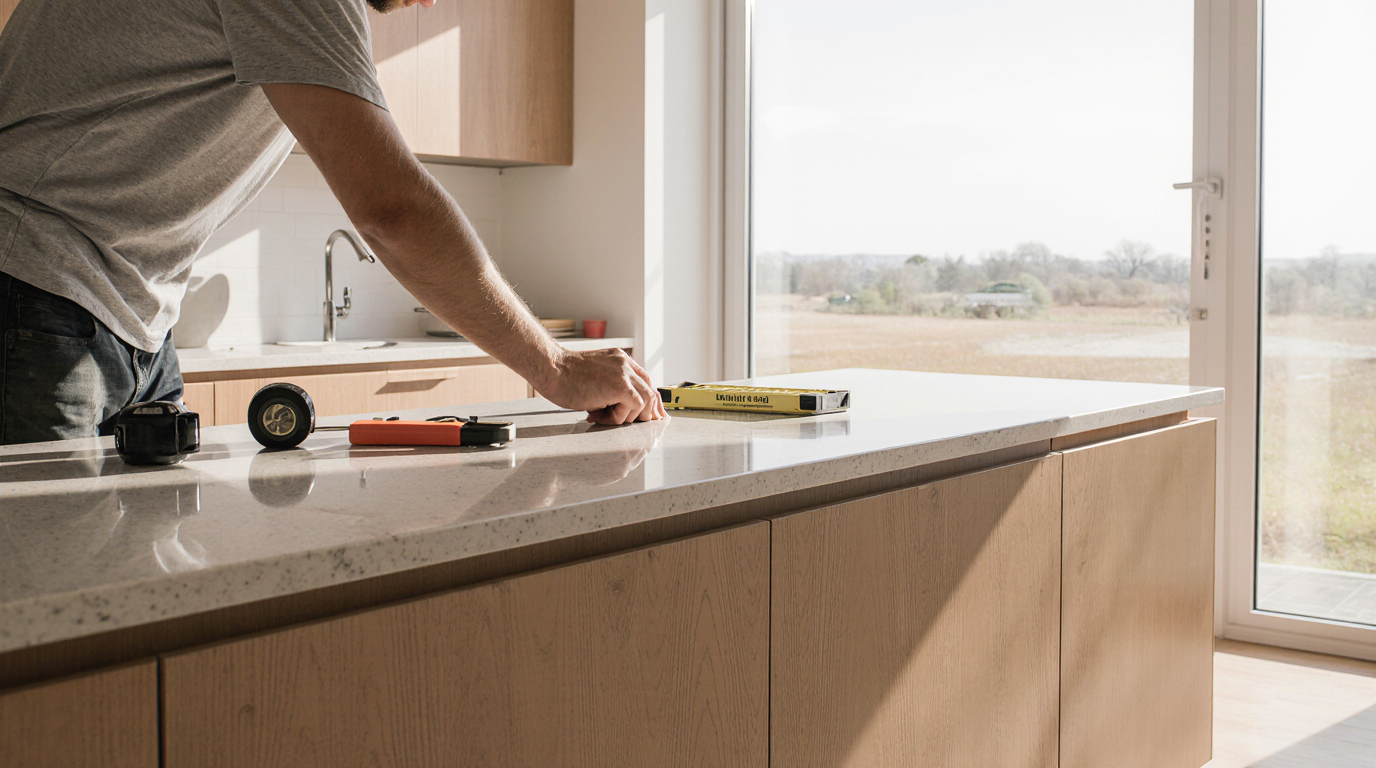
A typical countertop project here is a four-stage process: selection, templating, fabrication, and installation. After you select a slab from a local supplier, the fabricator visits your home to create a precise digital template of your cabinets. This is a critical step; any error here is permanent. This digital file then guides the CNC saws and waterjets at their facility to cut your slab.
Key Selection Criteria for Sarasota Homeowners
Choosing a fabricator and material in this market requires a specific lens. The intense sun in homes with large lanai doors and the constant humidity mean some popular choices elsewhere are risky here. Look for these specific qualities:
- UV Stability for Sun-Drenched Kitchens: If your kitchen gets direct, intense sunlight, ask for quartz brands with enhanced UV inhibitors to prevent yellowing over time, a known issue with some lower-quality resins.
- Proven Performance in Humid Conditions: Ask for examples of installations in non-air-conditioned spaces or lanais. This demonstrates the fabricator understands how materials behave in our climate.
- Experience with HOA Submittals: A good local fabricator will know the requirements for major communities like Palmer Ranch or University Park and can help prepare your application for a smoother approval process.
- Hurricane-Related Installation Standards: While not a direct building code for countertops, experienced installers understand how a home flexes and will use appropriate, high-grade adhesives that can handle structural shifts without cracking.
Comparing Top Countertop Materials for the Sarasota Climate
The choice of material goes far beyond looks. In Sarasota, it's an investment in durability against humidity, sun, and wear. A countertop that requires constant sealing can become a significant chore in a home that's closed up for the summer season. Here is how the top contenders stack up based on what truly matters in our local environment.
| Material | Humidity & Stain Resistance | UV Resistance (Fading/Yellowing) | Typical Installed Cost per Sq. Ft. |
|---|---|---|---|
| Engineered Quartz | Excellent (Non-Porous) | Good to Excellent (Varies by brand) | $80 - $150+ |
| Granite | Good (Requires Sealing) | Excellent | $70 - $140+ |
| Quartzite | Good (Requires Sealing) | Excellent | $90 - $200+ |
| Marble | Poor (Porous, Etches Easily) | Excellent | $100 - $250+ |
When a Full Slab Replacement Is the Wrong Choice
If you're planning to sell your home within a year or two and the existing countertops are simply dated but functional, a full, high-end renovation may not provide a positive return. For a quick refresh on a budget, professional resurfacing or a high-quality laminate can provide an updated look for a fraction of the cost, which might be a smarter financial move in a purely transactional scenario.
Safe Hiring Checklist for Sarasota Fabricators
Hiring the right team is more important than picking the perfect slab. A great fabricator can make a mid-range stone look spectacular, while a poor one can ruin the most exotic quartzite. I've been called in to fix mistakes that could have been avoided by checking these simple things upfront.
- Verify they hold a current license with Sarasota County and carry both General Liability and Worker's Compensation insurance. Ask for the certificate.
- Ask to see a project they installed over a year ago. New installations always look good; you want to see how their seams and fits hold up over time.
- Confirm they do their own fabrication and installation. Some companies are just sales fronts that subcontract the work, leaving you with no one accountable if issues arise.
- Inquire about their templating method. Digital templating is the standard for accuracy and is a must for complex layouts or kitchens with out-of-square walls.
- Review their policy on slab remnants. Will you get to keep the leftover pieces? These can be perfect for a small vanity top or cutting board.
- For condo renovations on barrier islands like Longboat Key, confirm the installer has experience coordinating with building management regarding elevator use, work hours, and debris removal.
The Decisions That Truly Determine Your Outcome
After years of overseeing these projects, I can pinpoint the moments where a renovation veers toward success or failure. The most successful clients are those who finalize every single detail—sink, faucet, cooktop, and outlet placements—before the fabricator comes to template. Any change after a template is made invites error, delays, and extra charges.
The Moment Most Homeowners Get It Wrong
The biggest mistake is choosing your slab from a small sample in a showroom. The pattern and veining on a 4x4-inch square can be completely different from the full slab. You must go to the stone yard and physically select your exact slab. Take a cabinet door and floor sample with you. I always insist my clients initial the back of their chosen slab with a marker; this ensures the slab you fell in love with is the one that arrives at the fabricator.
Practical Answers About Operations in Sarasota
Navigating the local specifics of a countertop renovation can be frustrating. Beyond selecting a material, you have to contend with local logistics and regulations that are unique to our area. Understanding these can prevent significant delays and unexpected costs.
Do I Need a Permit for Just Countertops in Sarasota?
Generally, a permit from the Sarasota County Building Department is not required if you are only replacing countertops and not altering any plumbing or electrical wiring. However, the moment you move a sink, add a new outlet for an appliance garage, or change gas lines for a new cooktop, you cross the line into permit territory. A licensed contractor must pull these permits, and the typical review time for such minor work can be 2-4 weeks.
How Do HOA Rules in Gated Communities Affect My Project?
In communities with a strong Architectural Review Board (ARB) or Design Review Committee (DRC), you cannot begin work without their written approval. They often have restrictions on work hours (e.g., no work before 8 AM), contractor vehicle parking, and debris disposal. Some even have pre-approved color palettes. Submitting your plans early is crucial, as the approval process alone can take 30 days or more, especially if the board only meets monthly.
What's Different About an Installation on a Barrier Island?
Working on Siesta Key, Lido Key, or Longboat Key involves unique logistical challenges. Condo associations have strict rules for freight elevator usage, which must be scheduled in advance. Installers must account for traffic on bridges, especially during tourist season. More importantly, using marine-grade stainless steel for any exposed fasteners or supports for an outdoor kitchen countertop is not optional; it's a necessity to prevent rapid corrosion from the salt air.