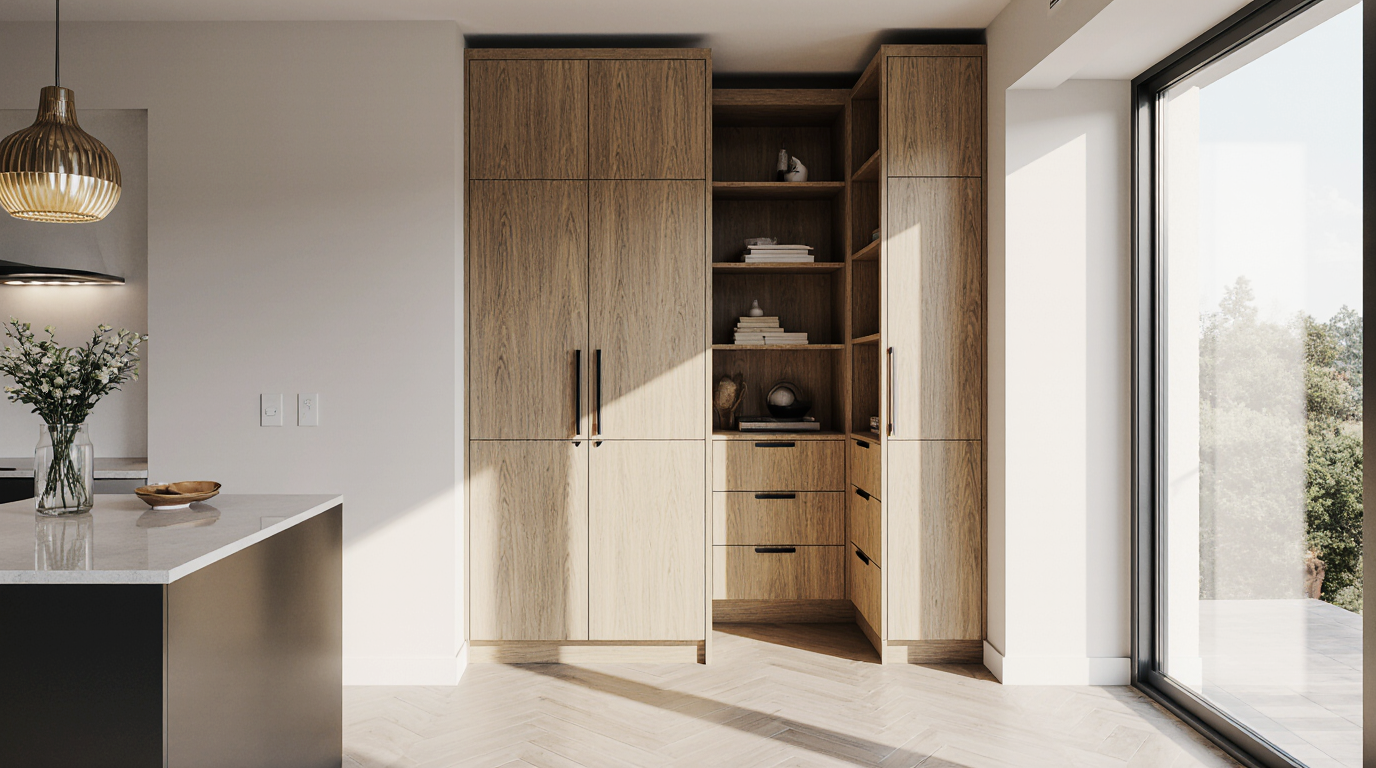
Diagnosing the Inherent Flaws in Standard Corner Cabinetry
When I assess a kitchen space for a new pantry, particularly in newer developments in Lakewood Ranch or renovated condos on Lido Key, my first step is to identify the 'invisible' environmental stressors. I look beyond the floor plan to analyze airflow, proximity to sliding glass doors, and the performance of the home's HVAC system. A common oversight I've identified in dozens of projects is the placement of pantries against exterior walls without adequate vapor barriers, creating a recipe for condensation and material decay. Standard off-the-shelf corner pantries, often built with particleboard or standard MDF, act like a sponge in these conditions.
My methodology begins with a moisture reading of the existing drywall and a thermal check for cold spots. This data dictates the level of cabinet sealing required. This diagnostic phase is critical because it moves the project from simple cabinet making to applied building science. A poorly specified corner unit doesn't just fail on its own; it can become a breeding ground for mold and compromise the surrounding cabinetry. Solving the corner pantry correctly is about protecting the entire kitchen investment.
The Technical Specification: Materials and Hardware Engineered for Coastal Life
The core of a durable cabinet lies in its composition. I advocate for a marine-grade plywood carcass, not because it's expensive, but because its cross-banded layers and waterproof phenolic adhesive provide superior dimensional stability. Unlike MDF, which can swell irreversibly by up to 20% of its thickness when exposed to moisture, this plywood maintains its form. For all joinery, I use dado and rabbet joints reinforced with specialized, moisture-resistant adhesives, a technique that provides far greater structural rigidity than the simple butt joints and screws found in mass-produced cabinets.
Hardware selection is equally critical. The salty air in Sarasota is incredibly corrosive. I've seen standard zinc-plated hinges show rust within 18 months. My standard is to use 316 stainless steel soft-close hinges and drawer slides. This specific alloy offers the highest corrosion resistance, ensuring smooth, silent operation for the life of the cabinet. For internal organization, such as lazy susans or pull-out systems, I specify mechanisms with high-load-bearing steel ball bearings, preventing the sagging and binding that plagues inferior plastic-based systems.
Fabrication and Installation: A Process of Precision
The transition from design to reality is where meticulous engineering pays off. My fabrication process ensures every component is purpose-built for its exact location and function. The steps are methodical and uncompromising:
- Precision Cutting: All plywood panels are cut using a CNC router to ensure tolerances within 1/64 of an inch. This guarantees perfectly square cabinets and seamless door gaps.
- Edge Banding and Sealing: Before assembly, every raw edge of the plywood is sealed with a waterproof sealant and then finished with a durable edge band. This is a crucial step often skipped to save costs, but it's the primary defense against moisture wicking into the wood core.
- Multi-Layer Finishing: The cabinet's exterior and interior receive a multi-stage finish, starting with a moisture-blocking primer followed by several coats of a catalyzed conversion varnish. This creates an impermeable, furniture-grade surface that is highly resistant to chipping, yellowing, and humidity.
- On-Site Scribing: No wall is perfectly plumb or level. During installation, I meticulously scribe each cabinet to the wall and floor, creating a seamless, built-in look that also seals the unit from dust and pests.
Final Adjustments and Quality Control for a Zero-Failure Standard
The final 5% of the installation is what defines a high-end custom project. Once the pantry cabinet is installed, I undertake a rigorous alignment process. This involves adjusting all door hinges to achieve perfectly uniform gaps and ensuring the soft-close mechanisms engage at the correct speed. I test every moving part under a simulated load to confirm it operates flawlessly. This meticulous attention to detail ensures the cabinet not only looks perfect but will withstand the daily demands of a busy household without needing constant readjustments. The goal is a functional piece of architectural millwork that feels as solid and reliable in year ten as it does on day one.
Given the unique challenges of our Sarasota climate, have you looked closely at your current pantry's door alignments and the condition of its lowest shelf for signs of moisture-related stress?