
Custom Butcher Block Countertops: The Engineering Protocol to Eliminate Warping in Sarasota's Coastal Climate
Beyond the Surface: A Diagnostic Approach to Wood Selection for Coastal Kitchens
The first point of failure in a butcher block is almost always the choice of wood species. While Hard Maple is a classic, its tight grain makes it susceptible to subtle but persistent expansion in the high-humidity environment of a Casey Key or Longboat Key home. I begin every project by analyzing the home's specific microclimate. A kitchen in an inland Lakewood Ranch estate faces different challenges than a condo on Lido Key with constant exposure to salt-laden air.
My material selection process prioritizes woods with superior dimensional stability and natural resistance to moisture. For instance, I frequently specify quarter-sawn White Oak for its medullary rays, which act as a natural structural reinforcement against cupping. For ultimate performance in the most demanding coastal applications, nothing surpasses the high oil content of Teak or Iroko. These species inherently repel water, a critical advantage that dramatically reduces the stress on any applied finish and prevents the microscopic failures that lead to long-term warping.
The Critical Choice: End-Grain vs. Edge-Grain Construction
The orientation of the wood grain is as crucial as the species itself. An end-grain construction, with the wood fibers oriented vertically, offers a remarkable self-healing quality ideal for direct chopping. However, it presents a significant engineering challenge in our climate, as it has hundreds of potential glue-line failure points. To counteract this, I utilize a specific cross-linking PVA adhesive, like Titebond III, which is fully waterproof and provides the structural integrity required to keep the individual blocks unified against humidity shifts.
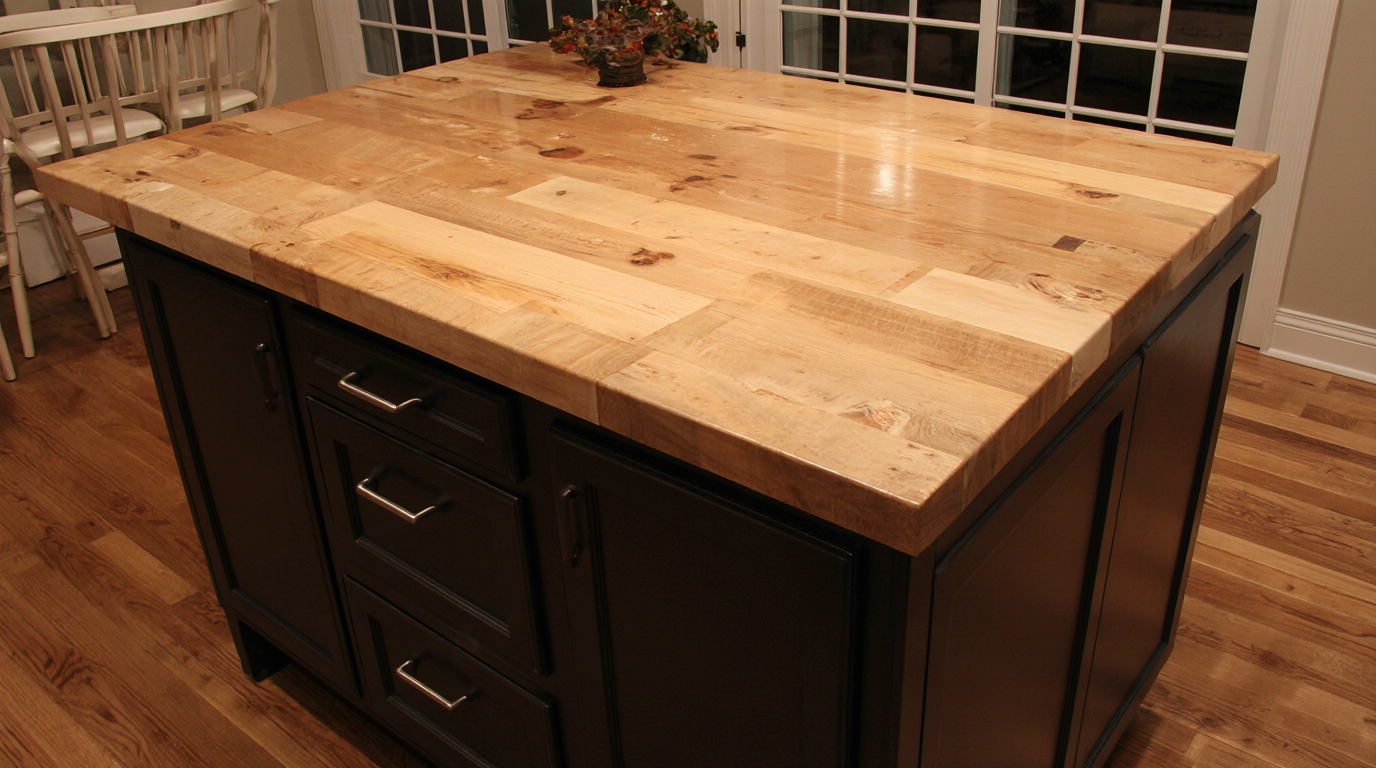
For countertops used more for prep and serving, an edge-grain construction provides greater overall stability. The key here is my lamination technique. I meticulously alternate the orientation of the growth rings for each wood strip. This simple step, often overlooked in mass production, creates opposing forces within the slab that effectively cancel out the natural tendency of the wood to cup in one direction. This results in a visibly flatter and structurally superior surface over its entire lifespan.
The Fabrication & Installation Protocol for a Zero-Failure Rate
A perfectly fabricated countertop can still fail if installed improperly. My process is built around acclimatization and accounting for natural wood movement, a non-negotiable factor in Florida.
- On-Site Acclimatization: Raw, milled lumber is delivered to the client's home and allowed to sit for a minimum of 7-10 days. This allows the wood to reach equilibrium with the home's specific ambient humidity *before* a single cut is made, preventing post-installation shock and movement.
- Balanced Sealing: I cannot stress this enough—sealing only the top surface is a recipe for disaster. The underside of the countertop must receive the exact same number of finishing coats as the top. This ensures a balanced rate of moisture exchange, which is the single most effective way to prevent warping.
- Engineered Expansion Gaps: Wood will always move. I install countertops with a precise 1/8-inch expansion gap around the perimeter, particularly where it meets walls or tile backsplashes. This gap is then discreetly concealed with trim, allowing the top to expand and contract seasonally without buckling or stressing the cabinetry beneath it.
Precision Integration with High-End Cabinetry and Appliances
Integrating a 3-inch thick butcher block around a high-end undermount sink or a professional cooktop demands absolute precision. All cutouts are potential entry points for water. My solution is to treat these vulnerable areas with multiple coats of penetrating marine-grade epoxy. This doesn't just seal the surface; it saturates the wood fibers of the end grain, creating an impenetrable, permanent barrier against moisture. Every installation is calibrated to a tolerance of 1/32 of an inch, ensuring a seamless, integrated fit that looks and feels like it is part of the home's original architecture.
Is your current kitchen design actively fighting Sarasota's humidity, or is it just a matter of time before the climate wins?
