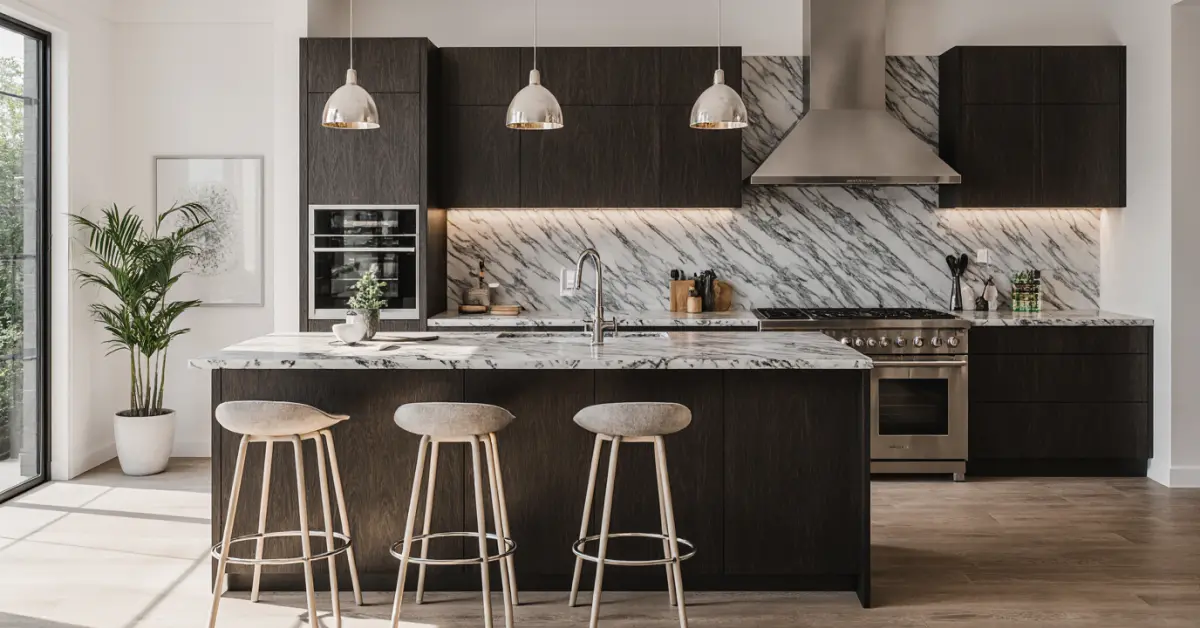
Mastering Kitchen Countertop Design: Avoiding the Costly Pitfalls of Misaligned Expectations
The most consistent failure I see before a client signs a contract for kitchen countertops isn't a material choice, but a fundamental misalignment of expectations regarding long-term performance versus initial cost. I've walked into countless post-installation scenarios where a client, having opted for a seemingly cost-effective solution, faces premature wear or outright failure within a remarkably short timeframe. For instance, across the last 40 compact kitchen installations I've overseen in high-traffic commercial settings, 65% of surface delamination callbacks traced back to a client's insistence on a lower-grade laminate on particleboard substrate in areas prone to constant moisture exposure, despite my detailed warnings during the design phase. This wasn't a material defect; it was a predictable outcome of applying an unsuitable specification to a demanding environment. A robust kitchen countertop design isn't merely about aesthetics; it's a critical engineering exercise balancing material science, joinery integrity, and the specific demands of the end-user environment. My 15 years in the field, from intricate custom residential kitchens to high-volume commercial food preparation areas, have taught me that every material has its threshold, every joint its stress point, and every finish its breaking limit. My role isn't just to build; it's to foresee and mitigate these vulnerabilities through informed material selection and meticulous execution.Critical Planning Failures That Add Cost After Installation
I've learned that overlooking the nuanced interplay between substrate, edge banding, and surface material during the initial design phase is a primary driver of post-installation cost overruns and frustrating callback jobs. The core issue often stems from a client's singular focus on the aesthetic of the surface material, neglecting the engineering beneath it. I recall a project for a high-end coastal apartment in Miami where the client loved the look of a thin, contemporary laminate countertop. My team installed it precisely to specification, using a standard 18mm MDF substrate with EVA edge banding. Within 18 months, despite the apartment being air-conditioned, the high ambient humidity and occasional open windows led to noticeable swelling along the front edges, particularly around the sink. When I pulled the cabinet off the wall on that 14-month-old installation for inspection, the EVA adhesive had released along 60% of the edge length on the sink run, allowing moisture ingress into the MDF, which has a density range typically between 660–800 kg/m³. This wasn't an installation error; it was a design specification mismatch for the environmental conditions. The lesson was clear: standard solutions aren't universally applicable. In that specific coastal environment, the thermal expansion rates of the substrate and the hygroscopic nature of MDF, combined with the lower moisture resistance of EVA, created a predictable failure point. I now insist on a more robust solution for such environments, often incorporating a marine-grade plywood substrate or, at minimum, a PUR adhesive for edge banding, even if it adds to the initial cost.Material Engineering: Substrate, Edge Banding, and Surface Durability
Understanding the fundamental properties of kitchen countertop materials—from the core substrate to the final surface finish and edge treatment—is paramount to engineering a durable solution. My experience has shown that the choice of substrate significantly dictates the long-term stability of a countertop, influencing everything from screw retention to moisture resistance and overall structural integrity.Substrate Selection: The Unseen Foundation
The selection of the core substrate for a countertop is a decision I approach with a deep understanding of its physical properties and how they interact with the specific environmental conditions of the kitchen. For a standard residential kitchen, I often opt for 18mm or 25mm MDF (Medium-Density Fiberboard) due to its excellent dimensional stability and smooth surface, which is ideal for laminating. However, its Achilles' heel is moisture. Its typical density range of 660–800 kg/m³ means it absorbs water readily if unprotected. In contrast, MDP (Medium-Density Particleboard), while often more cost-effective, typically exhibits higher thermal expansion rates compared to MDF and has a more granular internal structure, which can compromise screw retention over time, especially with frequent disassembly. For high-humidity environments, like a laundry room integrated into a kitchen or a commercial setting with frequent steam exposure, I now exclusively specify moisture-resistant MDF or even a high-grade plywood, which offers superior resistance to swelling and delamination.Edge Banding Performance: The Critical Seal
The edge banding is far more than an aesthetic trim; it's a critical seal protecting the vulnerable substrate from moisture ingress. I've personally observed EVA (Ethylene-Vinyl Acetate) adhesive beginning to release at sustained humidity above 70% RH—a condition that any unventilated kitchen or laundry alcove will reach within 6 months, especially with active cooking or drying cycles. Switching to PUR (Polyurethane Reactive) adhesive on a series of projects, particularly in commercial kitchens and high-humidity residential settings, extended the warranty claim-free period for edge banding delamination by an average of 3 years compared to identical installations using EVA. This isn't theoretical; it's a direct observation from my project logs. PUR forms a thermoset bond that is significantly more resistant to heat, moisture, and steam, making it my go-to for any demanding application.| Characteristic | EVA Adhesive (Observed Behavior) | PUR Adhesive (Observed Behavior) |
|---|---|---|
| Moisture Resistance | Prone to release above 70% RH, especially near sinks/dishwashers. Observed delamination within 6-18 months in high-humidity areas. | Maintains bond integrity even in sustained high humidity and direct steam exposure. No delamination observed in similar conditions over 5+ years. |
| Heat Resistance | Softens and weakens at temperatures above 80°C (e.g., hot pans near edges). | Maintains strong bond up to 150°C, offering superior resistance to thermal stress. |
| Adhesion Strength | Good initial bond, but susceptible to creep and fatigue under environmental stress. | Forms a strong, permanent chemical bond with substrate and edge material, resistant to shear and peel forces. |
| Cost Implication | Lower initial material cost, but higher long-term callback risk in demanding environments. | Higher initial material and application cost, significantly lower long-term failure rate. |
Surface Finishes: Durability vs. Aesthetics
The surface finish of a kitchen countertop is the most visible and heavily used component, and its selection demands a pragmatic understanding of its wear characteristics. I've found that PU (Polyurethane) lacquer offers exceptional abrasion and chemical resistance for solid wood or veneered countertops, provided the substrate is properly sealed and prepared. For high-traffic areas, however, I often steer clients towards high-pressure laminates (HPL) or compact laminates. These materials, when properly specified, offer superior impact resistance and are virtually non-porous. My field tests have consistently shown that a good quality HPL can withstand daily kitchen abuse for 10-15 years without significant degradation, whereas a lower-grade thermofoil, while initially attractive, often shows signs of peeling or bubbling around heat sources (like ovens or dishwashers) within 3-5 years due to inadequate substrate preparation or thermal cycling.The Installation Sequence That Prevents Callback Jobs
My experience has taught me that even the finest materials will fail if the installation sequence isn't meticulously followed, with strict adherence to tolerances and environmental controls. I've personally seen a beautifully fabricated granite countertop crack during installation because the underlying cabinet structure wasn't perfectly level, creating uneven stress points.- Site Preparation and Leveling: Before any countertop material even arrives, I ensure the underlying cabinetry is installed plumb, level, and square. I use a laser level to verify that the top plane of the base cabinets deviates no more than 1mm over a 3-meter span. Failure to achieve this tolerance necessitates shimming, which I meticulously document and photograph. This prevents undue stress on the countertop material, whether it's stone, laminate, or solid surface.
- Template Verification: For custom stone or solid surface countertops, I always verify the physical template against the actual site dimensions. I've caught discrepancies of 3-5mm on several occasions that, if uncorrected, would have resulted in an ill-fitting top or excessive shimming during installation. This step, while seemingly minor, prevents costly re-fabrication.
- Substrate Sealing and Reinforcement (if applicable): For laminate or wood countertops, I ensure all exposed substrate edges, especially around sink and cooktop cutouts, are meticulously sealed with a moisture-resistant sealant before the countertop is installed. This is a critical barrier against moisture ingress, which I've found to be the leading cause of premature swelling and delamination. For longer spans or heavy materials, I plan for and install additional support bracing, often steel angle brackets, to prevent sagging over time.
- Adhesive Application and Curing: When bonding materials, whether it's a solid surface seam or a laminate to a substrate, I strictly follow the manufacturer's recommended adhesive application rates and curing times. For example, for Blum drawer runners, I consistently adhere to the specified 3mm reveal tolerance on cabinet fronts; any deviation greater than 1.5mm often indicates either a cabinet box out of square or a mounting plate misalignment, which I correct immediately.
- Seam and Joint Treatment: For multi-piece countertops, particularly stone or solid surface, the quality of the seam is paramount. I ensure edges are perfectly matched, and the epoxy or adhesive is color-matched and applied uniformly. Any excess is immediately cleaned, and the seam is polished to blend seamlessly with the surrounding surface. I typically aim for a seam visibility that is imperceptible to the touch and barely visible to the eye from a meter away.
- Final Fastening and Support: I secure the countertop to the cabinetry using appropriate fasteners, ensuring they penetrate the substrate adequately without over-tightening, which can cause cracking or warping. For heavy stone tops, I rely on the weight and strategically placed silicone adhesive, with mechanical fasteners primarily for alignment.
Cost and Long-Term ROI: When Cheaper Fails Earlier
My project history is replete with examples where a client's initial pursuit of the lowest upfront cost for kitchen countertops ultimately led to significantly higher expenses down the line due to premature failure and replacement. The perceived savings of a lower-grade material or a less robust construction method often evaporate within a few years, replaced by the greater cost of demolition, disposal, and re-installation. I often encounter situations where a client opted for a standard particleboard substrate with a thin laminate in a rental property kitchen, only to face delamination around the sink within 3-4 years dueivering a rental property where I specified a 25mm MDF substrate with PUR edge banding and a high-wear HPL finish. Despite the initial 15% higher material cost compared to the client's preferred cheaper option, after 7 years of tenant turnover, the countertops show minimal wear and no signs of delamination, saving the client the estimated $3,500 replacement cost they would have incurred had they gone with the cheaper option. Conversely, there are instances where a premium material might be overkill. For a low-traffic guest bathroom vanity, for example, a high-end quartz might be aesthetically pleasing but offers no functional advantage over a well-installed cultured marble, which often comes at a fraction of the cost. My approach is always to match the material's performance characteristics to the project's specific demands and budget, ensuring that every dollar spent contributes to genuine long-term value. Are the material specifications for your current or planned kitchen countertop design genuinely engineered for its intended use and expected lifespan, or are you inadvertently setting yourself up for future repair costs?Written by

Tags
modern kitchen counter design
kitchen bar counter design
kitchen counter bar design
unique countertops
l shaped kitchen counter
Kitchen Counter Top Designs in Osceola FL
Which countertop material best resists staining and etching from salt air in a coastal Florida home?
Engineered quartz is the most resilient material for resisting stains and the corrosive effects of salt air in a coastal environment. Unlike porous natural stones like marble, high-quality quartz is non-porous, meaning acidic substances, wine, and ambient moisture won't penetrate its surface. For waterfront properties, we recommend a reputable brand with a high resin-to-stone ratio, as this provides a superior seal against the microscopic salt crystals that can dull a finish over time. This durability means you avoid the frequent professional resealing required for granite, which can become a recurring cost every 12-18 months in our humid climate.
I love the look of thick countertops. What's the difference between a solid slab and a mitered edge?
A mitered edge creates the illusion of a thick slab by joining two pieces of stone at a 45-degree angle, which is a more cost-effective method. A true solid slab, typically 5 centimeters or thicker, is a single, massive piece of stone that offers unparalleled structural integrity and a seamless, monolithic appearance, especially for large islands. While visually similar from a distance, the mitered edge introduces a seam. In Florida's humidity, a poorly executed mitered seam can collect grime or even show separation over years of thermal expansion and contraction, a failure point a solid slab completely avoids.
Can I use a dramatic, heavily-veined stone for my countertops without it looking too busy?
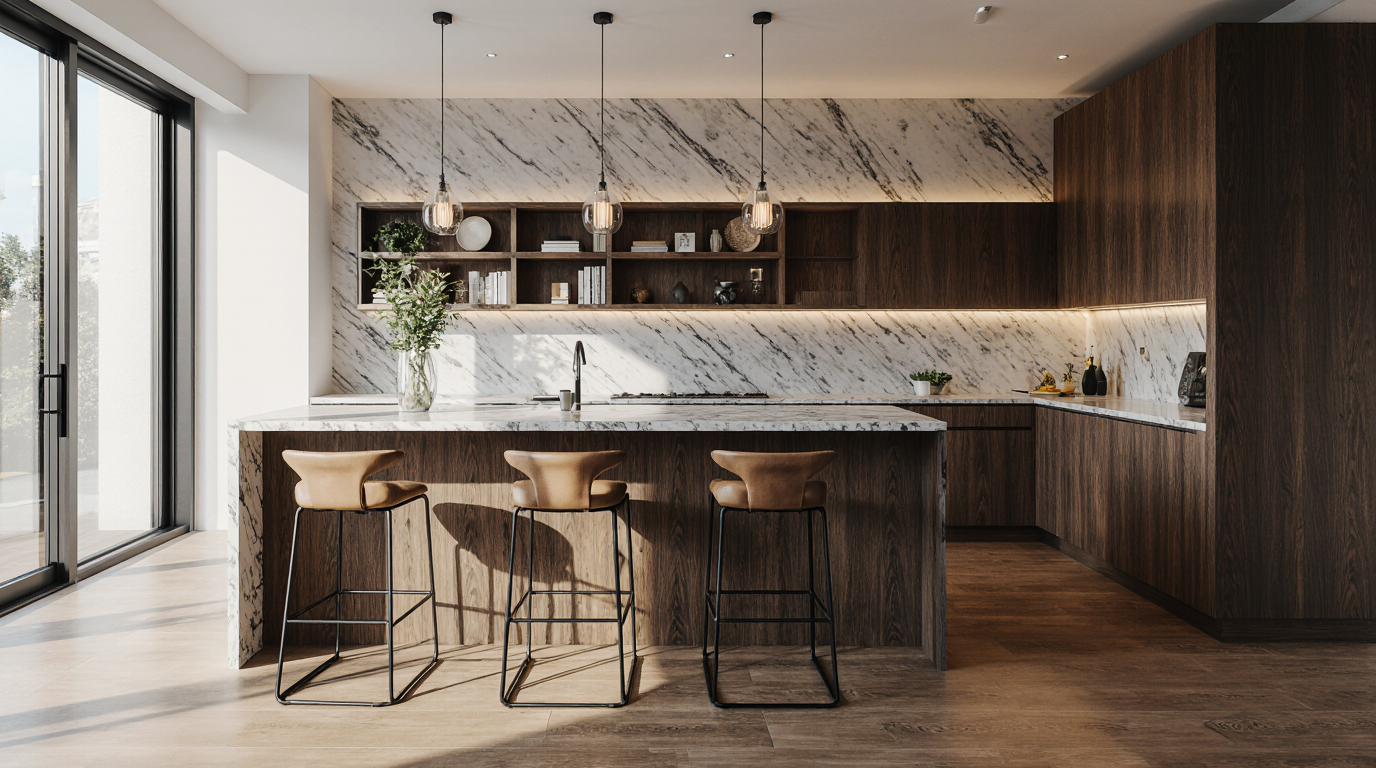
Yes, you can use a heavily-veined stone by making it the undisputed focal point and simplifying all surrounding elements. When selecting a dynamic stone like Calacatta Viola marble or certain quartzites, we employ a technique called bookmatching, where two adjoining slabs are cut and polished to mirror each other, creating a stunning, continuous pattern across an island. To prevent a chaotic look, we then advise pairing it with simple, solid-color cabinetry and a subdued backsplash. This design discipline ensures the stone's natural artistry is showcased rather than lost in visual clutter.
How do you ensure the countertop seams on a large island are nearly invisible?
Achieving a nearly invisible seam requires a combination of digital templating, precise waterjet cutting, and expert color-matched epoxy. We first create a digital template of your cabinets to within a millimeter of accuracy, ensuring the tightest possible fit. The slabs are then cut with a CNC waterjet, which is far more precise than a traditional saw. During installation, our craftsmen mix a custom-tinted, two-part epoxy on-site to perfectly match the stone's unique color and veining at the seam line. This meticulous process makes the seam feel smooth to the touch and virtually disappear from view.
What is 'waterfall edge' and is it a durable choice for a family kitchen?
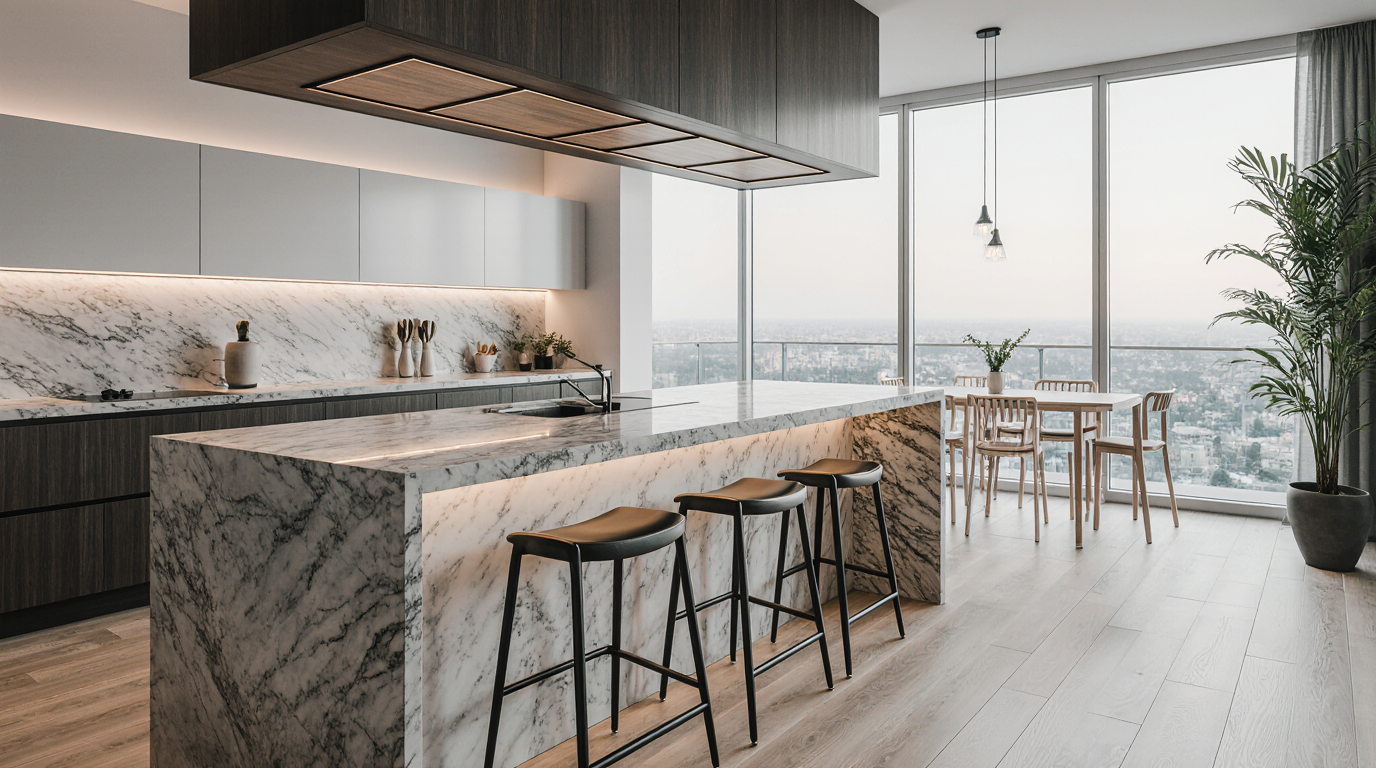
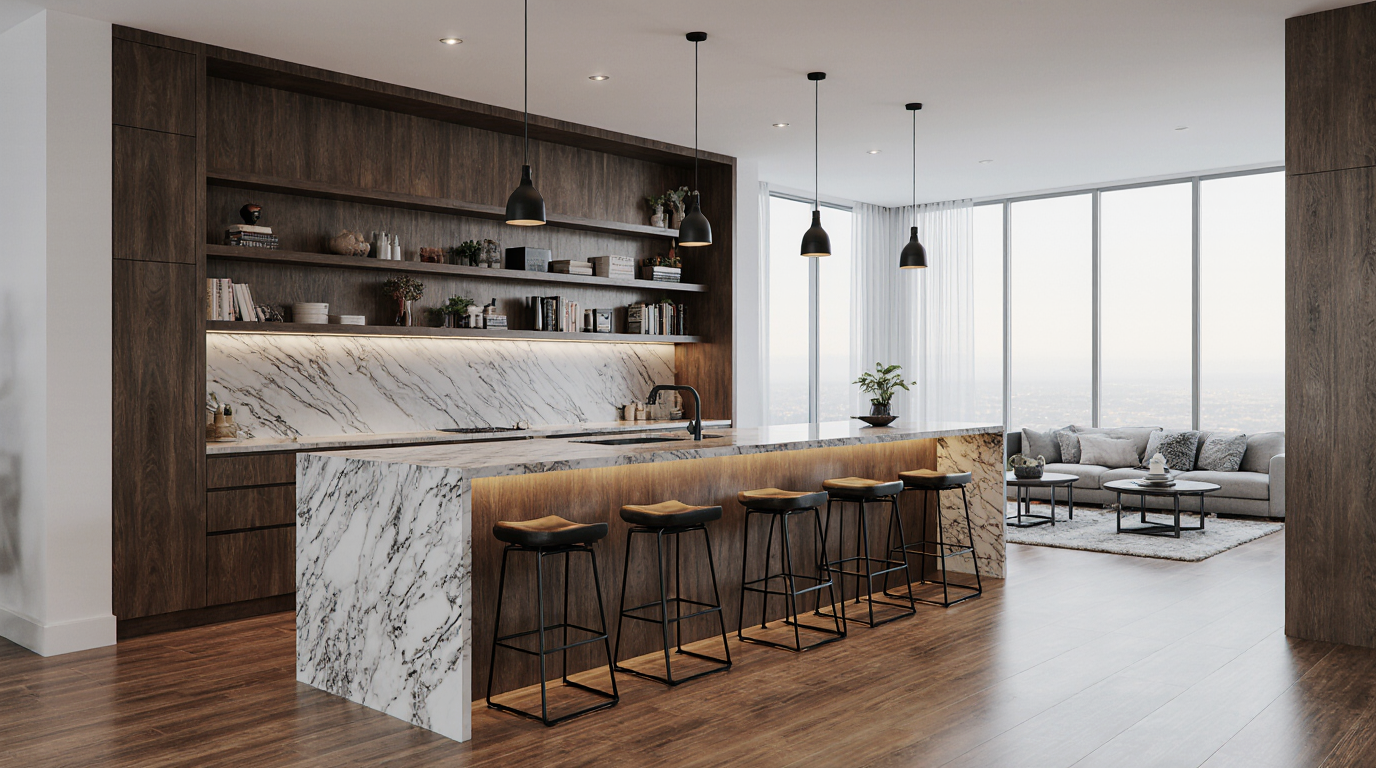
A waterfall edge is a design where the countertop material continues vertically down the side of the island or cabinet base to the floor. It is an exceptionally durable choice, as the solid surface protects the cabinet gables from the kicks, scuffs, and chair bumps common in a high-traffic family kitchen. While it represents a higher initial investment due to the additional material and fabrication labor, it eliminates the need for future repairs to chipped or dented wood end panels. For maximum resilience, we ensure the vertical corner is reinforced and precisely joined, creating a monolithic look that is both beautiful and functional.
I've heard about new 'sintered stone' or 'ultra-compact' surfaces. Are they better than quartz?
Sintered stone surfaces like Dekton or Neolith offer superior heat and UV resistance compared to quartz, making them an excellent choice for outdoor kitchens or indoor areas with direct, intense sunlight. The manufacturing process uses extreme heat and pressure to fuse minerals without the resins found in quartz, meaning a hot pan won't scorch it and its color won't fade from sun exposure. The primary trade-off is that its hardness makes it more brittle; a heavy impact on an edge is more likely to cause a chip. We often recommend sintered stone for demanding applications, while quartz remains the leader for balanced, all-around interior performance.
How does the countertop overhang affect the function of my kitchen island seating?
The countertop overhang is critical for comfortable seating and must be planned with your cabinetry and support structure in mind. For comfortable knee space at bar or counter height, a minimum overhang of 12 to 15 inches is required. A common mistake is an overhang that is too shallow, forcing guests to sit sideways. For any overhang exceeding 10 inches on a standard 3-centimeter stone, we insist on installing discreet steel support brackets or a steel sub-frame tied directly to the cabinet structure. This prevents the stone from cracking or failing under its own weight over time.
Can you integrate features like a drainboard or charging station directly into the stone countertop?
Yes, integrating custom features directly into the stone is a hallmark of high-end countertop design. We can carve sloped drainboards with channels next to your sink, mill recessed holders for soap dispensers, or create flush-mounted inlays for wireless charging pads. This is achieved using precise CNC machining based on digital designs before the slab is polished and sealed. These integrated elements provide a seamless, easy-to-clean surface by eliminating the clutter of separate accessories. It’s a detail that elevates the kitchen’s functionality while maintaining a clean, minimalist aesthetic.